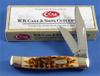
I found 2 rusty fixed blade knifes a 5 Finn and a M5F but thru more polishing than I care to admit they are back to like new condition all but the paint. I have tried Enamel but won't stick after it dries, I'm preparing to try Enamel Paste when it arrives in the mail but if this doesn't work I'm kinda outta ideas. Any knowledge on the subject would be greatly appreciated Thanks.
Painting Scroll work.
- bigmike3063
- Posts: 6
- Joined: Tue Feb 15, 2011 3:02 am
- Location: Kentucky
Painting Scroll work.
Does anyone know the method Case used to paint the 1977 Blue Scroll edition knifes.
I found 2 rusty fixed blade knifes a 5 Finn and a M5F but thru more polishing than I care to admit they are back to like new condition all but the paint. I have tried Enamel but won't stick after it dries, I'm preparing to try Enamel Paste when it arrives in the mail but if this doesn't work I'm kinda outta ideas. Any knowledge on the subject would be greatly appreciated Thanks.
- Madmarco
- Gold Tier

- Posts: 12039
- Joined: Wed May 20, 2020 12:09 am
- Location: Smack dab in the middle of Canada
Re: Painting Scroll work.
Hey Mike! There is no point in re-posting a subject you're interested in. Just post it 1 time and check back regularly to see if anyone has supplied you any answers, double-posting won't make it happen any sooner. Oh, btw,bigmike3063 wrote: ↑Mon Dec 06, 2021 1:57 am Does anyone know the method Case used to paint the 1977 Blue Scroll edition knifes.
I found 2 rusty fixed blade knifes a 5 Finn and a M5F but thru more polishing than I care to admit they are back to like new condition all but the paint. I have tried Enamel but won't stick after it dries, I'm preparing to try Enamel Paste when it arrives in the mail but if this doesn't work I'm kinda outta ideas. Any knowledge on the subject would be greatly appreciated Thanks.![]()
-
Desert Golfer
- Bronze Tier

- Posts: 223
- Joined: Thu Sep 03, 2020 9:43 am
- Location: Arizona
Re: Painting Scroll work.
I don`t know the exact method Case used but the paint almost certainly was applied with a machine and the paint most likely was Epoxy. 
- rea1eye
- Posts: 2661
- Joined: Fri Mar 13, 2015 2:59 am
Re: Painting Scroll work.
Possibly contact W.R. Case?
Bob
Bob
- bigmike3063
- Posts: 6
- Joined: Tue Feb 15, 2011 3:02 am
- Location: Kentucky
Re: Painting Scroll work.
Thanks for the Epoxy suggestion I hadn't considered that. Thanks for the idea
I did try the Case route and never received a email back so I turned to All About Pocket Knifes.. Thanks for the suggestion.
- Mumbleypeg
- Gold Tier

- Posts: 15704
- Joined: Fri Apr 18, 2014 1:28 am
- Location: Republic of Texas
Re: Painting Scroll work.
One of the members here, who goes by the handle “hardman” has posted in the Case Collector’s Club Forum about his method of restoring the color to etched blades of several different colors, with pictures of his results. Maybe he will see this and explain here about his technique and what materials he uses. If not you could send him a PM.
Ken
Ken
Member AKTI, TSRA, NRA.
If your religion requires that you hate someone, you need a new religion.
When the people fear their government, that is tyranny. When government fears the people, that is freedom.
https://www.akti.org/
If your religion requires that you hate someone, you need a new religion.
When the people fear their government, that is tyranny. When government fears the people, that is freedom.
https://www.akti.org/
-
ea42
- Posts: 3194
- Joined: Tue Oct 17, 2006 8:23 pm
- Location: Wallkill, NY
Re: Painting Scroll work.
Maybe nail polish or modelling paint?
I don't know that you'll ever get it right at this point since you likely removed a good deal of metal and detail when polishing.
Eric
I don't know that you'll ever get it right at this point since you likely removed a good deal of metal and detail when polishing.
Eric
-
hardman
- Gold Tier

- Posts: 519
- Joined: Mon Jan 18, 2016 5:15 pm
Re: Painting Scroll work.
Per Ken's suggestion, this has been copied and pasted from my very first post on this Forum.
====================================================================
This process only works on DEEP BLADE etches. If you try what follows on the more modern surface "etch," which is really just paint on the surface of the blade without the color actually being deposited in a subsurface depression in the blade, I suspect you will do MUCH more harm than good.
If the etch needing repair has a gold fill, a good product to use is Liquid Leaf from Plaid. If it is any other color, use a good grade of enamel, the kind that is sold in tiny bottles for hobbyists. Clean the blade thoroughly using first mineral spirits and then alcohol. Vigorously shake your paint as the product has a tendency to settle and separate very quickly. Using a fine tipped artist's brush (cheaper the better), paint over the letters or design of the deep blade etch with your paint/coating. Do not try to paint the letters, just paint over them. Be sure you completely cover the etch and the area around it. At first, the paint/coating will hide the design of your etch under the coating. Then, you wait. You need to let it dry completely. Hours, not minutes. As it dries, you will see that the paint actually dries flat to the knife surface and the deep blade etch again becomes visible through the paint coating. Then, using a single edged razor blade, carefully lay the sharp edge of the razor blade very, very flat on the knife blade. Angle it slightly, being sure to keep the edge of the razor blade flat against the knife blade. Applying some pressure to the center of the razor blade to insure that the blade stays flat to the surface, slowly and carefully pull the razor blade along the length of the knife blade. (Remember, you are not trying to remove metal, only the unwanted portion of the coating. So, don't press too hard.) The razor scrapes the paint/coating off of the raised surface of the knife blade, leaving behind the paint that fills the subsurface areas of your blade etch. It may take a couple of passes to get it all. And, that's it. The blade etch is once again color filled. If you didn't get it completely the first time, try again.
Remember this only works on knives with a subsurface, preferably deep, blade etch. Here are pictures of some blades repaired using the above process. The Case Railsplitter Jack 5299 1/2 had lost its gold etched fill completely. So, there was no color at all on the blade. No black, no gold. The process described above is what brought the color back. The third picture is of two Case 5165 Folding Hunters that go back to 1976 and were a Bicentennial Commemorative. The top one shown was used by its previous owner and there was no color fill left to any part of the blade etch. It was 'restored' using the above process with blue and red enamel. The bottom knife in the picture is a factory original Bicentennial Folding Hunter to use for comparison. This one was more difficult as the blade etch was not as deep. So, this took several passes. I hope this helps you out. Finally, there is a picture of a Case Bulldog Clasp knife, both before and after.
====================================================================
This process only works on DEEP BLADE etches. If you try what follows on the more modern surface "etch," which is really just paint on the surface of the blade without the color actually being deposited in a subsurface depression in the blade, I suspect you will do MUCH more harm than good.
If the etch needing repair has a gold fill, a good product to use is Liquid Leaf from Plaid. If it is any other color, use a good grade of enamel, the kind that is sold in tiny bottles for hobbyists. Clean the blade thoroughly using first mineral spirits and then alcohol. Vigorously shake your paint as the product has a tendency to settle and separate very quickly. Using a fine tipped artist's brush (cheaper the better), paint over the letters or design of the deep blade etch with your paint/coating. Do not try to paint the letters, just paint over them. Be sure you completely cover the etch and the area around it. At first, the paint/coating will hide the design of your etch under the coating. Then, you wait. You need to let it dry completely. Hours, not minutes. As it dries, you will see that the paint actually dries flat to the knife surface and the deep blade etch again becomes visible through the paint coating. Then, using a single edged razor blade, carefully lay the sharp edge of the razor blade very, very flat on the knife blade. Angle it slightly, being sure to keep the edge of the razor blade flat against the knife blade. Applying some pressure to the center of the razor blade to insure that the blade stays flat to the surface, slowly and carefully pull the razor blade along the length of the knife blade. (Remember, you are not trying to remove metal, only the unwanted portion of the coating. So, don't press too hard.) The razor scrapes the paint/coating off of the raised surface of the knife blade, leaving behind the paint that fills the subsurface areas of your blade etch. It may take a couple of passes to get it all. And, that's it. The blade etch is once again color filled. If you didn't get it completely the first time, try again.
Remember this only works on knives with a subsurface, preferably deep, blade etch. Here are pictures of some blades repaired using the above process. The Case Railsplitter Jack 5299 1/2 had lost its gold etched fill completely. So, there was no color at all on the blade. No black, no gold. The process described above is what brought the color back. The third picture is of two Case 5165 Folding Hunters that go back to 1976 and were a Bicentennial Commemorative. The top one shown was used by its previous owner and there was no color fill left to any part of the blade etch. It was 'restored' using the above process with blue and red enamel. The bottom knife in the picture is a factory original Bicentennial Folding Hunter to use for comparison. This one was more difficult as the blade etch was not as deep. So, this took several passes. I hope this helps you out. Finally, there is a picture of a Case Bulldog Clasp knife, both before and after.
- Attachments
-
- 101_3617.JPG (34.88 KiB) Viewed 1033 times
-
- 101_3616.JPG (32.49 KiB) Viewed 1033 times
-
- 101_3644.JPG (26.5 KiB) Viewed 1032 times
Gary
"Now it cuts like a knife, but it feels so right." Bryan Adams


- bigmike3063
- Posts: 6
- Joined: Tue Feb 15, 2011 3:02 am
- Location: Kentucky