


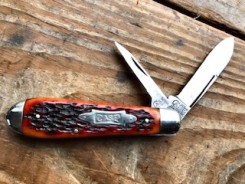
OK, I'm still new enough not to have a real idea on this one. The knife is an Ohio Cutlery Tru-Temper. Secondary blade is broken. The handles are kind of translucent, which makes me think plastic, but there are definite layers, and on the pile side you can feel them. I tried to capture that in the third photo.
Question is: what is this material? I originally bought the knife thinking I'd make it a single blade user like a couple of others I have done, but I'm pretty sure the scales will come apart if I try to take the knife apart. If they're plastic I probably don't care, but if this is some cool kind of bone, then I may leave it as it is.
Any ideas?
Handle material identification
-
beresman
- Silver Tier

- Posts: 609
- Joined: Fri Jul 24, 2020 7:19 pm
- Location: Ohio
- Contact:
-
orvet

- Gold Tier

- Posts: 19906
- Joined: Tue May 16, 2006 6:23 am
- Location: Willamette Valley, Oregon
Re: Handle material identification
That's beautiful example of some earlier celluloid.
Very similar to the kind that I've seen on some made by New York Knife Co. as well as some of the older companies. I think Ulster made something similar to that also.
Very similar to the kind that I've seen on some made by New York Knife Co. as well as some of the older companies. I think Ulster made something similar to that also.
Dale
AAPK Administrator
Please visit my AAPK store: www.allaboutpocketknives.com/orvet
Job 13:15
"Buy more ammo!" - Johnnie Fain
“Evil is Powerless If The Good are Unafraid.” – Ronald Reagan
AAPK Administrator
Please visit my AAPK store: www.allaboutpocketknives.com/orvet
Job 13:15
"Buy more ammo!" - Johnnie Fain
“Evil is Powerless If The Good are Unafraid.” – Ronald Reagan
-
orvet
- Gold Tier
- Posts: 19906
- Joined: Tue May 16, 2006 6:23 am
- Location: Willamette Valley, Oregon
Re: Handle material identification
My suggestion for your knife:
If you're not familiar with celluloid, it does have a tendency to break down over time and release sulfuric and nitric acids. The reddish haze on the bolsters next to the celluloid handle is an indicator that the celluloid is destabilized and is beginning to off gas. If allowed to continue it will pretty well the knife alive.
When I see a knife like that I immediately remove the handles, it's probably pretty easy because it's probably brittle by now. A thin knife blade, like a kitchen knife is probably all it will take to slide underneath the handle and pop it off in pieces. Then my recommendation would be to wash the knife thoroughly in baking soda and water to help neutralize the acid.
Then you can re-handle the knife.
Sorry, in my first post I was answering your question about the material on the handle. After posting I went back and looked and could see that the celluloid was beginning to off gas, so I thought I should inform you about that also.
It's your knife, and you can do whatever you wish with it. I'm not in the business of telling people what to do with their knives unless they ask, but I also don't like to see people new to the hobby be uninformed.
If you're not familiar with celluloid, it does have a tendency to break down over time and release sulfuric and nitric acids. The reddish haze on the bolsters next to the celluloid handle is an indicator that the celluloid is destabilized and is beginning to off gas. If allowed to continue it will pretty well the knife alive.
When I see a knife like that I immediately remove the handles, it's probably pretty easy because it's probably brittle by now. A thin knife blade, like a kitchen knife is probably all it will take to slide underneath the handle and pop it off in pieces. Then my recommendation would be to wash the knife thoroughly in baking soda and water to help neutralize the acid.
Then you can re-handle the knife.
Sorry, in my first post I was answering your question about the material on the handle. After posting I went back and looked and could see that the celluloid was beginning to off gas, so I thought I should inform you about that also.
It's your knife, and you can do whatever you wish with it. I'm not in the business of telling people what to do with their knives unless they ask, but I also don't like to see people new to the hobby be uninformed.
Dale
AAPK Administrator
Please visit my AAPK store: www.allaboutpocketknives.com/orvet
Job 13:15
"Buy more ammo!" - Johnnie Fain
“Evil is Powerless If The Good are Unafraid.” – Ronald Reagan
AAPK Administrator
Please visit my AAPK store: www.allaboutpocketknives.com/orvet
Job 13:15
"Buy more ammo!" - Johnnie Fain
“Evil is Powerless If The Good are Unafraid.” – Ronald Reagan
-
richard
- Posts: 737
- Joined: Sun Jul 08, 2018 12:25 am
Re: Handle material identification
It will make a great single blade e.d.c. but get them handle's off, you can use them as a template for making new handles ,i would use hard wood just saying.
i would love to see it when finished.
i would love to see it when finished.
-
beresman
- Silver Tier
- Posts: 609
- Joined: Fri Jul 24, 2020 7:19 pm
- Location: Ohio
- Contact:
Re: Handle material identification
OK, that's what I wondered. Yes, I saw the corrosion on the bolsters and thought that might be the issue, but I've never seen any kind of plastic de-laminate like that before (and I worked in the plastics industry for a few years). It's kind of a pity because I really like the look of the handles, but not what it'll do to the rest of the knife.
SO anyway, I'll do what I originally planned to do, which is take it apart and make it a single-blade knife with new scales. Another handle project!
Oh, and Dale, the compressor tool worked great on the last project knife I re-assembled. Thanks!
SO anyway, I'll do what I originally planned to do, which is take it apart and make it a single-blade knife with new scales. Another handle project!
Oh, and Dale, the compressor tool worked great on the last project knife I re-assembled. Thanks!
Brent
-
herbva
- Gold Tier
- Posts: 2074
- Joined: Thu Oct 11, 2018 7:18 pm
- Location: The Old Dominion
Re: Handle material identification
In the meantime, before you start work on it, I recommend that you DO NOT store it with or around other knives. The gas produced by the outgassing celluloid can destroy other knives in the vicinity, particularly if stored in the same container. It is a shame, many of these old celluloid patterns were very cool. 
"Better to do something imperfectly, than to do nothing flawlessly." ~ Robert H. Schuller
Herb
Herb
-
beresman
- Silver Tier
- Posts: 609
- Joined: Fri Jul 24, 2020 7:19 pm
- Location: Ohio
- Contact:
Re: Handle material identification
Actually, I already got the knife apart this afternoon, and it's sitting on my workbench now. I'm trying to think of something I could do with the scales to show them off that will keep them from anything that can be harmed by the outgassing...herbva wrote: ↑Fri Mar 05, 2021 11:30 pm In the meantime, before you start work on it, I recommend that you DO NOT store it with or around other knives. The gas produced by the outgassing celluloid can destroy other knives in the vicinity, particularly if stored in the same container. It is a shame, many of these old celluloid patterns were very cool.
Brent
-
orvet
- Gold Tier
- Posts: 19906
- Joined: Tue May 16, 2006 6:23 am
- Location: Willamette Valley, Oregon
Re: Handle material identification
I'm glad the spring compressor is working well for you.
I can't think of a thing that I can do with off-gassing celluloid. I know how pretty it looks but once they start to off-gas I throw them away, in the garbage can. The reason is working them can cause an explosion I am told. The friction of buffing them or sanding them is it enough to ignite I have heard stories of people buffing Celluloid handles and having them ignite or even explode.
I have heard stories of people having Celluloid handles ignite when buffing or sanding them. The friction generates enough Heat to light them on fire. Chemically I guess Celluloid is very similar in composition to nitrocellulose which is used in explosives. I'm not a chemist but according to the way Wikipedia explained it they are very similar. I don't trust decomposing Celluloid to set around my shop. Call me paranoid but nothing good could come up at! You also don't know how long those handles have been decomposing. They may have been decomposing for 30 years. Or they may have started decomposing last month. They're not consistent in the rate at which they decompose. That's what makes them so dangerous as far as I'm concerned.
I can't think of a thing that I can do with off-gassing celluloid. I know how pretty it looks but once they start to off-gas I throw them away, in the garbage can. The reason is working them can cause an explosion I am told. The friction of buffing them or sanding them is it enough to ignite I have heard stories of people buffing Celluloid handles and having them ignite or even explode.
I have heard stories of people having Celluloid handles ignite when buffing or sanding them. The friction generates enough Heat to light them on fire. Chemically I guess Celluloid is very similar in composition to nitrocellulose which is used in explosives. I'm not a chemist but according to the way Wikipedia explained it they are very similar. I don't trust decomposing Celluloid to set around my shop. Call me paranoid but nothing good could come up at! You also don't know how long those handles have been decomposing. They may have been decomposing for 30 years. Or they may have started decomposing last month. They're not consistent in the rate at which they decompose. That's what makes them so dangerous as far as I'm concerned.
Dale
AAPK Administrator
Please visit my AAPK store: www.allaboutpocketknives.com/orvet
Job 13:15
"Buy more ammo!" - Johnnie Fain
“Evil is Powerless If The Good are Unafraid.” – Ronald Reagan
AAPK Administrator
Please visit my AAPK store: www.allaboutpocketknives.com/orvet
Job 13:15
"Buy more ammo!" - Johnnie Fain
“Evil is Powerless If The Good are Unafraid.” – Ronald Reagan
-
knife7knut
- Posts: 10697
- Joined: Tue Nov 06, 2007 9:02 pm
- Location: Tecumseh,Michigan
Re: Handle material identification
Just read the Wikipedia treatise on "gun cotton" which is another name for nitrocellulose. Kind of long but definitely worth reading. After you do you will probably throw away every celluloid handled knife you own! 
Adventure BEFORE Dementia!
-
TazmanTom18
- Posts: 231
- Joined: Tue Sep 19, 2017 2:22 pm
Re: Handle material identification
Maybe seal them up with a seal-a-meal. Fairly clear and should contain the gassing. Worth a shot... Tom
-
knife7knut
- Posts: 10697
- Joined: Tue Nov 06, 2007 9:02 pm
- Location: Tecumseh,Michigan
Re: Handle material identification
A good thought but the problem with nitrocellulose is it contains it's own oxygen atoms so it can degrade in a vacuum.TazmanTom18 wrote: ↑Sat Mar 06, 2021 2:33 pm Maybe seal them up with a seal-a-meal. Fairly clear and should contain the gassing. Worth a shot... Tom
Adventure BEFORE Dementia!
-
geocash

- Posts: 1980
- Joined: Mon Sep 24, 2018 8:25 pm
- Location: Southern Appalachian Mountains, outdoors preferably
Re: Handle material identification
It surprises me how long some knife manufacturers continued using celluloid. I don't have a knife with celluloid, to my knowledge, & don't plan to ever get one but I'm curious about what others have experienced. I assume there are variations in celluloid, like most anything else. My questions are: has anyone noticed a knife manufacturer that used celluloid with an unusually long or short lifespan or a celluloid manufacturer that had an unusually long or short lasting celluloid?
geocash
-
RobesonsRme.com

- Posts: 10129
- Joined: Wed Jan 28, 2009 3:44 pm
- Location: The Heart of Dixie.
- Contact:
Re: Handle material identification
Pete Cohan told me once that the National Knife Museum’s method of preserving an out gassing vintage knife was disassembly and coat all parts in RustOleum Clear Coat.
That produces a knife that is then only a display piece and I have no idea of its permanence.
Charlie
That produces a knife that is then only a display piece and I have no idea of its permanence.
Charlie
DE OPPRESSO LIBER
"...Men may spurn our appeals, reject our message, oppose our arguments, despise our persons ___but they are helpless against our prayers. "
Sidlow Baxter
"...Men may spurn our appeals, reject our message, oppose our arguments, despise our persons ___but they are helpless against our prayers. "
Sidlow Baxter
-
knife7knut
- Posts: 10697
- Joined: Tue Nov 06, 2007 9:02 pm
- Location: Tecumseh,Michigan
Re: Handle material identification
If it was the original formula Rust-O-Leum(which is fish oil based)I could see it working.I have a friend who is a body man that used to buy a new car every couple years and rather than have the dealer undercoat it(this was before cars came from the factory with undercoating)he would spray the entire underside with Rust-O-Leum thinner. Never had a problem with rust. The only down side is it cannot be re-painted afterward.If you try re-coating;even with Rust-O-Leum it will lift.RobesonsRme.com wrote: ↑Sun Mar 07, 2021 3:57 pm Pete Cohan told me once that the National Knife Museum’s method of preserving an out gassing vintage knife was disassembly and coat all parts in RustOleum Clear Coat.
That produces a knife that is then only a display piece and I have no idea of its permanence.
Charlie
I found this out because I used to use it for lettering trucks.When a customer wanted the lettering removed on the doors of his truck,we tried everything including sanding it to bare metal;etching it with acid and re-painting.After a couple days you could still see the outlines of the lettering.
Adventure BEFORE Dementia!
-
herbva
- Gold Tier
- Posts: 2074
- Joined: Thu Oct 11, 2018 7:18 pm
- Location: The Old Dominion
Re: Handle material identification
It's a real mystery to me. I get a lot of knives with outgassing celluloid for restoration and unlike other synthetic materials that manufacturers have improved over time, celluloid actually seems to me to be getting worse. I've had vintage celluloid knives from the early 1900's that showed no signs of deterioration ("grenading" as some call it) and some knives only a few years old that were already going bad. I don't mean cast aspersions on all German knife manufacturers, but I have worked on a lot of German knives that were only a few years old and the celluloid had already grenaded. You would think they would either stop using celluloid or come up with a more stable version.geocash wrote: ↑Sun Mar 07, 2021 2:29 pm It surprises me how long some knife manufacturers continued using celluloid. I don't have a knife with celluloid, to my knowledge, & don't plan to ever get one but I'm curious about what others have experienced. I assume there are variations in celluloid, like most anything else. My questions are: has anyone noticed a knife manufacturer that used celluloid with an unusually long or short lifespan or a celluloid manufacturer that had an unusually long or short lasting celluloid?
"Better to do something imperfectly, than to do nothing flawlessly." ~ Robert H. Schuller
Herb
Herb
-
beresman
- Silver Tier
- Posts: 609
- Joined: Fri Jul 24, 2020 7:19 pm
- Location: Ohio
- Contact:
Re: Handle material identification
I haven't had a ton of knives pass through my hands, but I started out with collecting more modern German knives. I have a very pretty Buck Creek knife that I have isolated on the basis of this--it's still gorgeous, but the exposed part of the blades has some patina that the rest of the blades does not. I bought an Indian Head that I was thinking I would re-handle, but the springs are so corroded that one is already broken, and the other isn't far behind. And I've seen a couple others like that since I've started looking on eBay for project knives with decent blades. One was a Keen Kutter, but most are later German makes.herbva wrote: ↑Sun Mar 07, 2021 6:04 pm
It's a real mystery to me. I get a lot of knives with outgassing celluloid for restoration and unlike other synthetic materials that manufacturers have improved over time, celluloid actually seems to me to be getting worse. I've had vintage celluloid knives from the early 1900's that showed no signs of deterioration ("grenading" as some call it) and some knives only a few years old that were already going bad. I don't mean cast aspersions on all German knife manufacturers, but I have worked on a lot of German knives that were only a few years old and the celluloid had already grenaded. You would think they would either stop using celluloid or come up with a more stable version.
So I can agree with your assessment that some German knives seem to be particularly problematic. I read somewhere recently (on this forum, I think) that early Imperial/Hammer knives didn't seem to have the problem. I also have a few Kent and other Camillus-made products that seem to be OK so far. So you may be right that the process used earlier was better and more recent products have employed some kind of short-cut (read: cost cutting) which exacerbated the outgassing problem.
Brent
-
knife7knut
- Posts: 10697
- Joined: Tue Nov 06, 2007 9:02 pm
- Location: Tecumseh,Michigan
Re: Handle material identification
Here is a great example of cel degradation.Looked nice from the outside and when I went to press down on the lock to close it,the end broke off in my hands!
- Attachments
-
-
-
Adventure BEFORE Dementia!
-
beresman
- Silver Tier
- Posts: 609
- Joined: Fri Jul 24, 2020 7:19 pm
- Location: Ohio
- Contact:
Re: Handle material identification
Looks like a Buck Creek logo?knife7knut wrote: ↑Sun Mar 07, 2021 9:50 pm Here is a great example of cel degradation.Looked nice from the outside and when I went to press down on the lock to close it,the end broke off in my hands!
Brent
-
herbva
- Gold Tier
- Posts: 2074
- Joined: Thu Oct 11, 2018 7:18 pm
- Location: The Old Dominion
Re: Handle material identification
Well, don't throw that one away. A few months ago I bought a small collection of Winchester knives (5) with 1989-1992 tang stamps that had been put away in storage brand new and the cell scales were quietly outgassing in storage. I am guessing that the owner never checked on them until too late. (I don't know who actually made these knives for Winchester, but the celluloid was of course the short-lived variety.) I thought they didn't look too bad from the auction pics (not ebay), but looks can be deceiving. I just finished rehandling the last of them. The last one I worked on is a jumbo toothpick, and when I started to disassemble it, it fell apart in my hands just like your knife. The corrosion actually ate through the liners. So, I had an extra step to do of making new brass liners and transferring the bolsters to the new liners. It is a bit time consuming, but not as hard as you might think.knife7knut wrote: ↑Sun Mar 07, 2021 9:50 pm Here is a great example of cel degradation.Looked nice from the outside and when I went to press down on the lock to close it,the end broke off in my hands!
"Better to do something imperfectly, than to do nothing flawlessly." ~ Robert H. Schuller
Herb
Herb
-
knife7knut
- Posts: 10697
- Joined: Tue Nov 06, 2007 9:02 pm
- Location: Tecumseh,Michigan
Re: Handle material identification
beresman wrote: ↑Sun Mar 07, 2021 10:07 pmIt was.Bought it brand new and it was gone in less than two years.knife7knut wrote: ↑Sun Mar 07, 2021 9:50 pm Here is a great example of cel degradation.Looked nice from the outside and when I went to press down on the lock to close it,the end broke off in my hands!
Looks like a Buck Creek logo?
Adventure BEFORE Dementia!
-
knife7knut
- Posts: 10697
- Joined: Tue Nov 06, 2007 9:02 pm
- Location: Tecumseh,Michigan
Re: Handle material identification
Threw it out a long time ago.First knife I ever threw away.herbva wrote: ↑Sun Mar 07, 2021 10:19 pmWell, don't throw that one away. A few months ago I bought a small collection of Winchester knives (5) with 1989-1992 tang stamps that had been put away in storage brand new and the cell scales were quietly outgassing in storage. I am guessing that the owner never checked on them until too late. (I don't know who actually made these knives for Winchester, but the celluloid was of course the short-lived variety.) I thought they didn't look too bad from the auction pics (not ebay), but looks can be deceiving. I just finished rehandling the last of them. The last one I worked on is a jumbo toothpick, and when I started to disassemble it, it fell apart in my hands just like your knife. The corrosion actually ate through the liners. So, I had an extra step to do of making new brass liners and transferring the bolsters to the new liners. It is a bit time consuming, but not as hard as you might think.knife7knut wrote: ↑Sun Mar 07, 2021 9:50 pm Here is a great example of cel degradation.Looked nice from the outside and when I went to press down on the lock to close it,the end broke off in my hands!
Adventure BEFORE Dementia!