


Handle Material Before Delrin
-
tvic
- Silver Tier

- Posts: 2886
- Joined: Tue May 25, 2021 3:32 pm
- Location: North Carolina
Handle Material Before Delrin
So knives made before the invention of Delrin (c. 1960) that have some sort of man made material for the handles - exactly what is it? For example, I have a black handle, jigged, obviously to mimic bone, but all I can find for an explanation on these earlier knives is "synthetic." It's not celluloid unless it has some fancy colors to it, right? So, is "synthetic" just another name for some for of plastic?? Enlighten me, please!
Tim
“Live simply, love generously, care deeply, speak kindly, leave the rest to God.” - Ronald Reagan
“Live simply, love generously, care deeply, speak kindly, leave the rest to God.” - Ronald Reagan
-
Mumbleypeg

- Gold Tier

- Posts: 15707
- Joined: Fri Apr 18, 2014 1:28 am
- Location: Republic of Texas
Re: Handle Material Before Delrin
Yes, synthetic is pretty much the name used for most man-made pre-Delrin knife handle materials not celluloid. Probably because there are so many different ones of generally unknown chemical composition. Which is why the name “composition” is sometimes used also. Most of those pre-Delrin man made materials had problems with shrinkage, or some other manner of deterioration over time.
There been many different formulas including hard rubber, “rubberloid”, gutta percha, some shellac-based compounds, and so on. Many of them are rarely seen today because they just didn’t survive. Obviously some did though, so we have them around to make us curious what they are and who made them. Remember, knives were simply tools to be used up and thrown away, until knife collectors came along and started wondering about what they were made of!
Thankfully today we have Delrin, and several much improved man made materials like Micarta, Corelon, etc.
Ken
There been many different formulas including hard rubber, “rubberloid”, gutta percha, some shellac-based compounds, and so on. Many of them are rarely seen today because they just didn’t survive. Obviously some did though, so we have them around to make us curious what they are and who made them. Remember, knives were simply tools to be used up and thrown away, until knife collectors came along and started wondering about what they were made of!
Thankfully today we have Delrin, and several much improved man made materials like Micarta, Corelon, etc.
Ken
Member AKTI, TSRA, NRA.
If your religion requires that you hate someone, you need a new religion.
When the people fear their government, that is tyranny. When government fears the people, that is freedom.
https://www.akti.org/
If your religion requires that you hate someone, you need a new religion.
When the people fear their government, that is tyranny. When government fears the people, that is freedom.
https://www.akti.org/
-
tvic
- Silver Tier
- Posts: 2886
- Joined: Tue May 25, 2021 3:32 pm
- Location: North Carolina
Re: Handle Material Before Delrin
Thanks, Ken! Very helpful.
Tim
“Live simply, love generously, care deeply, speak kindly, leave the rest to God.” - Ronald Reagan
“Live simply, love generously, care deeply, speak kindly, leave the rest to God.” - Ronald Reagan
-
Sharpnshinyknives

- Gold Tier
- Posts: 6311
- Joined: Mon Jul 16, 2018 2:32 am
- Location: Indiana
- Contact:
Re: Handle Material Before Delrin
Isn’t there a post on this material referred to as “shrinky dink” somewhere here on the forums? That black material that shrinks up so badly on old knives has been referred to by that name and other names. Can’t find the link or I would post it.
SSk Mark
Visit my AAPK store here: https://www.allaboutpocketknives.com/sharpnshinyknives
Visit my AAPK store here: https://www.allaboutpocketknives.com/sharpnshinyknives
-
dsutton24

- Posts: 137
- Joined: Sun Sep 11, 2022 11:49 pm
- Location: Illinois
Re: Handle Material Before Delrin
The black material used as knife scales was probably Vulcanite. Gutta Percha remains resilient after curing. Vulcanite can be cut, machined and polished, and it does shrink and curl over time.
-
treefarmer
- Gold Tier
- Posts: 15158
- Joined: Sun Oct 04, 2009 6:53 am
- Location: Florida Panhandle(LA-Lower Alabama)
Re: Handle Material Before Delrin
Why does “gum fuddy” seem to come to mind?
Treefarmer
Treefarmer
A GUN IN THE HAND IS BETTER THAN A COP ON THE PHONE.
-
edge213

- Gold Tier
- Posts: 8472
- Joined: Sat Jan 25, 2014 12:48 am
- Location: The Crossroads of America
Re: Handle Material Before Delrin
Case called the old rough black gum fuddy.
David
"Glowing like the metal on the edge of a knife" Meat Loaf
"Glowing like the metal on the edge of a knife" Meat Loaf
-
tongueriver

- Posts: 7239
- Joined: Tue Sep 16, 2008 8:01 pm
Re: Handle Material Before Delrin
Two of the earlier ones not mentioned are bakelite and Fosterene, both with known chemistry.
-
cody6268

- Bronze Tier

- Posts: 4091
- Joined: Fri Apr 10, 2015 7:51 pm
- Location: Southwestern Virginia
Re: Handle Material Before Delrin
I have heard the "Rubberloid" used by LF&C was essentially Bakelite, correct?
-
zzyzzogeton

- Posts: 1842
- Joined: Tue Jun 20, 2017 8:47 pm
- Location: In the Heart of Texas on the Blackland Prairie
Re: Handle Material Before Delrin
The following is about Western fixed blades made by Western, not those made for them by 3rd parties.
Western used bakelite as their primary "non-natural" handle material from 1928 through the end of WW2 and a littlebeyond as they used up war surplus parts (the brown swirl bakelite).
Western used the generic term "composition, non-breakable plastic" for their non-bakelite, non-natural materials.
Pearl, amber, amber cream, yellow, agate, goldstone, assorted color, golden shell, pearl composition with special black and underlayment, and pyralin were the primary advertising terms for the celluloid and celluloid-like plastics].
The colored plastics of the 1940s and 1950s bird & trouts were called - tenite and phenolic.
Apparently, they sourced their handle material from more than one company as some handles act like celluloid and shrink badly. Other versions are just as intact as the day they were attached to 1931 and 1936 knives.
The pearl compositiion with special black underlayment seems to be the worst of the off-gassing villains.
Western was one of the first, if not the first, to offer knives with Delrin handles. Delrin only became commercially available in early-to-mid 1961, which is when Western replaced virtually every stag and bone handled knife with Delrin handles, all in "bone stag".
The leading model number digit "5" for stag was eliminated and "6" transformed from being the indicator of "bone stag" and "bone" to being the Delrin indicator.
Western used bakelite as their primary "non-natural" handle material from 1928 through the end of WW2 and a littlebeyond as they used up war surplus parts (the brown swirl bakelite).
Western used the generic term "composition, non-breakable plastic" for their non-bakelite, non-natural materials.
Pearl, amber, amber cream, yellow, agate, goldstone, assorted color, golden shell, pearl composition with special black and underlayment, and pyralin were the primary advertising terms for the celluloid and celluloid-like plastics].
The colored plastics of the 1940s and 1950s bird & trouts were called - tenite and phenolic.
Apparently, they sourced their handle material from more than one company as some handles act like celluloid and shrink badly. Other versions are just as intact as the day they were attached to 1931 and 1936 knives.
The pearl compositiion with special black underlayment seems to be the worst of the off-gassing villains.
Western was one of the first, if not the first, to offer knives with Delrin handles. Delrin only became commercially available in early-to-mid 1961, which is when Western replaced virtually every stag and bone handled knife with Delrin handles, all in "bone stag".
The leading model number digit "5" for stag was eliminated and "6" transformed from being the indicator of "bone stag" and "bone" to being the Delrin indicator.
-
tongueriver
- Posts: 7239
- Joined: Tue Sep 16, 2008 8:01 pm
Re: Handle Material Before Delrin
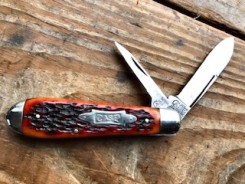
Here is a Western with the brown swirly.
-
herbva
- Gold Tier
- Posts: 2074
- Joined: Thu Oct 11, 2018 7:18 pm
- Location: The Old Dominion
Re: Handle Material Before Delrin
Very informative ZZZ. I have often wondered exactly what "composition" meant, and why I see some knives with "composition" scales from pre-delrin, decades ago that look just fine and others, well, they turned to shXX a long time ago. Thanks!zzyzzogeton wrote: ↑Tue Nov 15, 2022 5:21 pm The following is about Western fixed blades made by Western, not those made for them by 3rd parties.
Western used bakelite as their primary "non-natural" handle material from 1928 through the end of WW2 and a littlebeyond as they used up war surplus parts (the brown swirl bakelite).
Western used the generic term "composition, non-breakable plastic" for their non-bakelite, non-natural materials.
Pearl, amber, amber cream, yellow, agate, goldstone, assorted color, golden shell, pearl composition with special black and underlayment, and pyralin were the primary advertising terms for the celluloid and celluloid-like plastics].
The colored plastics of the 1940s and 1950s bird & trouts were called - tenite and phenolic.
Apparently, they sourced their handle material from more than one company as some handles act like celluloid and shrink badly. Other versions are just as intact as the day they were attached to 1931 and 1936 knives.
The pearl compositiion with special black underlayment seems to be the worst of the off-gassing villains.
Western was one of the first, if not the first, to offer knives with Delrin handles. Delrin only became commercially available in early-to-mid 1961, which is when Western replaced virtually every stag and bone handled knife with Delrin handles, all in "bone stag".
The leading model number digit "5" for stag was eliminated and "6" transformed from being the indicator of "bone stag" and "bone" to being the Delrin indicator.
"Better to do something imperfectly, than to do nothing flawlessly." ~ Robert H. Schuller
Herb
Herb