


After extensive review and research and lost sleep…. Here is a summary
1. What “Pressed Stag” Means
Material: Usually starts with smooth cow bone (or occasionally a synthetic resin) rather than actual antler.
Process:
The blank handle material is heated.
A die or mold with antler-like texture is pressed into the surface — this is where the term pressed comes from.
The surface is often stained or dyed in multiple tones to mimic the color variation of natural stag.
Result: From a distance, it can resemble real stag, with ridges and valleys similar to antler bark, but the pattern is mechanically uniform rather than naturally random
2. Authentic Stag Antler
Material: True stag is cut from naturally shed deer or elk antlers (often sambar stag from India due to its dense texture).
Appearance:
Naturally irregular bark pattern — no two pieces are alike.
Can have varied color from creamy ivory to deep brown depending on age and exposure.
Often left in “bark” form (outer surface intact) for texture and grip.
Durability: Very strong, dense, and naturally resistant to cracking if properly cured.
⸻
Pressed Stag (Bone/Resin)
Authentic Stag Antler
Origin
Cow bone or synthetic resin
Naturally shed antler (deer, elk, etc.)
Texture
Mold-impressed, repeated pattern
Naturally irregular, random pattern
Color
Dyed or stained to simulate stag
Natural tones, sometimes polished or torched
Durability
Strong, but can chip if bone; resin may warp
Dense, highly durable if well-cured
Cost
Less expensive
More expensive due to rarity and labor
Collectability
Generally less sought by purists
Highly valued in traditional knives
Feel in Hand
Consistent ridges; slightly artificial texture
Warm, organic, varied texture
4. Key Differences in Practice
• Look closely at pressed stag and you’ll often see repeating or symmetrical “antler” grooves — something nature never does.
• Weight and warmth: Authentic stag tends to feel warmer and heavier than resin-based pressed stag, but close to bone in density.
• Wear over time: Real stag develops a polished patina on high points from handling, while pressed stag’s dye can fade, exposing the base material.
⸻
spotting pressed stag vs. real stag when looking at a knife handle.
⸻
1. Look for Pattern Repetition
• Pressed stag: Because it’s made with a mold or die, the “bark” pattern often repeats — you might see identical ridges or valleys on both sides of the handle, or even across different knives from the same production run.
• Real stag: Completely unique; nature doesn’t make mirror-image grooves. Even matching sides on a single knife will have subtle differences.
⸻
2. Check the Cross-Section
If you can see the edge of the scale where it meets the tang:
• Pressed stag (bone): The dye or color often stops near the surface, and underneath you may see lighter bone or even smooth material.
• Real stag: The bark texture continues inward, with a natural gradient of color that doesn’t look “painted on.”
⸻
3. Feel the Texture
• Pressed stag: Often has a slightly “soft” or rounded ridge feel from pressing rather than carving — edges can feel uniform.
• Real stag: Bark ridges are sharper, more angular, and irregular. Some spots may be very smooth (worn from handling), others deeply grooved.
⸻
4. Look at the Color
• Pressed stag: Color is added after molding, often with darker tones in grooves and lighter on ridges. You might notice the shading looks a little too uniform.
• Real stag: Colors blend naturally from cream to deep brown without an obvious “airbrushed” look.
⸻
5. Tap & Listen
• Bone pressed stag: Produces a sharper “click” sound when tapped against metal.
• Resin pressed stag: Slightly duller tap.
• Real stag: Has a dense, warm “click” somewhere between bone and horn — less brittle sounding than bone.
⸻
6. Aging Signs
• Pressed stag: High spots may lose dye first, exposing plain white bone underneath.
• Real stag: High spots polish to a shine but keep their color; grooves may darken from handling oils.
Here’s a quick reference on when and where pressed stag shows up most often so you can keep your collector radar sharp:
⸻
1. Case Cutlery – 1940s–1960s
• Why: During and after WWII, real stag imports (especially Sambar stag from India) were scarce. Case and other U.S. makers turned to jigged and pressed bone to simulate stag.
• What to watch for: Case knives from the late Tested and early XX eras sometimes have “stag” that’s actually bone jigged and pressed, especially on lower-cost patterns.
⸻
2. German Export Knives – 1950s–1970s
• Why: Many Solingen makers (Böker, Puma, Carl Schlieper, and contract makers for Sears, Western Auto, and others) used pressed bone or resin for U.S. export to keep prices competitive.
• What to watch for: Handles with perfect mirror-image texture on both sides — a hallmark of molded pressed stag.
⸻
3. Schrade & Camillus – Mid-20th Century
• Why: U.S. factory knives marketed as “stag handled” in catalogs were often pressed bone to hit a price point.
• What to watch for: Especially common on hunters and folding hunters sold in department stores.
⸻
4. Postwar Sheffield Knives – 1950s–1980s
• Why: U.K. makers like Taylor’s Eye Witness, Ibberson, and George Wostenholm used pressed stag bone for export knives, especially slipjoints.
• What to watch for: Very even, shallow grooves; high gloss from polishing.
⸻
5. Modern Low- to Mid-Grade Imports – 1980s–Present
• Why: Cost-cutting on knives from Pakistan, China, and some lower-tier European makers.
• What to watch for: Resin “stag” with unnatural colors (bright orange, yellow) and perfectly symmetrical patterns.
PRESSED STAG More than u ever wanted to know
-
Miller Bro's

- Gold Tier

- Posts: 13631
- Joined: Mon Feb 16, 2009 11:22 pm
- Location: Earth
Re: PRESSED STAG More than u ever wanted to know
"Pressed stag" doesn't exist as far as I know.bocaj wrote: ↑Fri Aug 08, 2025 8:39 pm 1. What “Pressed Stag” Means Material: Usually starts with smooth cow bone (or occasionally a synthetic resin) rather than actual antler.
Process:
The blank handle material is heated.
A die or mold with antler-like texture is pressed into the surface — this is where the term pressed comes from.
The surface is often stained or dyed in multiple tones to mimic the color variation of natural stag.
Result: From a distance, it can resemble real stag, with ridges and valleys similar to antler bark, but the pattern is mechanically uniform rather than naturally random
This subject has repeatedly been brought up over the years by a handful of people, nothing I repeat nothing has been proven to date that it exists.
I would love to see the actual evidence

AAPK Janitor
369
369
-
Mumbleypeg

- Gold Tier
- Posts: 15689
- Joined: Fri Apr 18, 2014 1:28 am
- Location: Republic of Texas
Re: PRESSED STAG More than u ever wanted to know
Bocaj, do you have any pictures of pressed stag? I’ve seen pressed bone and pressed horn, second cut stag, and numerous kinds of actual stag antler covers, including stag antlers long prior to the advent of Sambar stag. I’ve also seen molded “Plastag” and other synthetics molded and colored to mimic actual stag. Having seen thousands of knives I don’t recall ever seeing “pressed stag” but it’s possible I just wasn’t aware what to look for.
Ken
Ken
Member AKTI, TSRA, NRA.
If your religion requires that you hate someone, you need a new religion.
When the people fear their government, that is tyranny. When government fears the people, that is freedom.
https://www.akti.org/
If your religion requires that you hate someone, you need a new religion.
When the people fear their government, that is tyranny. When government fears the people, that is freedom.
https://www.akti.org/
-
ThatWeirdKnifeGuy
- Gold Tier
- Posts: 1660
- Joined: Tue Jul 25, 2023 8:20 pm
- Location: Wisconsin
Re: PRESSED STAG More than u ever wanted to know
So it's not antler. Its bone. Like this?

I've seen this exact pattern in the bone on other knives. So i assume that's done with a mold and press and not a cutting device of some type?
- Attachments
-
https://newlifeknives.etsy.com That's my Etsy store where I sell old knives and sometimes handmade knife accessories to support my knife habbit. Thanks for looking my friend.

-
edge213

- Gold Tier
- Posts: 8456
- Joined: Sat Jan 25, 2014 12:48 am
- Location: The Crossroads of America
Re: PRESSED STAG More than u ever wanted to know
This is jigged bone.ThatWeirdKnifeGuy wrote: ↑Fri Aug 08, 2025 11:34 pmSo it's not antler. Its bone. Like this?
I've seen this exact pattern in the bone on other knives. So i assume that's done with a mold and press and not a cutting device of some type?
David
"Glowing like the metal on the edge of a knife" Meat Loaf
"Glowing like the metal on the edge of a knife" Meat Loaf
-
ThatWeirdKnifeGuy
- Gold Tier
- Posts: 1660
- Joined: Tue Jul 25, 2023 8:20 pm
- Location: Wisconsin
Re: PRESSED STAG More than u ever wanted to know
You're not wrong.edge213 wrote: ↑Sat Aug 09, 2025 3:39 amThis is jigged bone.ThatWeirdKnifeGuy wrote: ↑Fri Aug 08, 2025 11:34 pmSo it's not antler. Its bone. Like this?
I've seen this exact pattern in the bone on other knives. So i assume that's done with a mold and press and not a cutting device of some type?
However, it's advertised as "stag bone". Which is just bone made to look like stag. This is my knife and another just like it on ebay.
The jigging looks identical, though the dye is different. So is it cut or pressed? Arguing semantics to be the devils advocate here.
- Attachments
-
-
https://newlifeknives.etsy.com That's my Etsy store where I sell old knives and sometimes handmade knife accessories to support my knife habbit. Thanks for looking my friend.
-
treefarmer
- Gold Tier
- Posts: 15143
- Joined: Sun Oct 04, 2009 6:53 am
- Location: Florida Panhandle(LA-Lower Alabama)
Re: PRESSED STAG More than u ever wanted to know
This thread reminded me of Queen's description of handle material, bone stag, Queen stag, referring to the imitation Winterbottom handles made of Delrin. Most every knife of the same pattern has identical "jigging" from a mold, color may vary from knife to knife.
My 2 cents worth.
Treefarmer
My 2 cents worth.
Treefarmer
A GUN IN THE HAND IS BETTER THAN A COP ON THE PHONE.
-
wlf

- Gold Tier
- Posts: 6244
- Joined: Thu Mar 24, 2011 2:55 am
- Location: WV
Re: PRESSED STAG More than u ever wanted to know
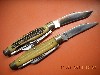
This is what some of us call "pressed stag". ( regardless of your belief it's a term that I’ve heard since I started collecting). These are worn. The German versions are different from the English.
The first knife is English and the 2nd is German. Handle material never seen on American made knives. Lots of opinions ( none with proof )and unanswered questions.
The first knife is English and the 2nd is German. Handle material never seen on American made knives. Lots of opinions ( none with proof )and unanswered questions.
- Attachments
-
-
-
Code: Select all
[b][b]Wanted GEC 641113s Trade or buy[/b][/b]May the Father and Son bless
Lyle
-
btrwtr

- Gold Tier
- Posts: 5478
- Joined: Thu May 24, 2012 11:53 am
Re: PRESSED STAG More than u ever wanted to know
Pressed horn- certainly exists with many examples.Miller Bro's wrote: ↑Fri Aug 08, 2025 9:47 pm"Pressed stag" doesn't exist as far as I know.bocaj wrote: ↑Fri Aug 08, 2025 8:39 pm 1. What “Pressed Stag” Means Material: Usually starts with smooth cow bone (or occasionally a synthetic resin) rather than actual antler.
Process:
The blank handle material is heated.
A die or mold with antler-like texture is pressed into the surface — this is where the term pressed comes from.
The surface is often stained or dyed in multiple tones to mimic the color variation of natural stag.
Result: From a distance, it can resemble real stag, with ridges and valleys similar to antler bark, but the pattern is mechanically uniform rather than naturally random
This subject has repeatedly been brought up over the years by a handful of people, nothing I repeat nothing has been proven to date that it exists.
I would love to see the actual evidence
Pressed stag or pressed bone - as you said, no evidence of this material existing ever presented. As I have said before, as easy and prevalent as it is to dye and jig bone why would anyone go to the expense, labor and trouble required to press it? Making a silk purse out of a sow's ear comes to mind.
If I have seen further it is by standing on the shoulders of giants.
Wayne
Please visit My AAPK store https://www.allaboutpocketknives.com/catalog/btrwtr
Wayne
Please visit My AAPK store https://www.allaboutpocketknives.com/catalog/btrwtr
-
edge213
- Gold Tier
- Posts: 8456
- Joined: Sat Jan 25, 2014 12:48 am
- Location: The Crossroads of America
Re: PRESSED STAG More than u ever wanted to know
"Jigged bone" is cut (jigged) into the bone by a machine, not pressed.ThatWeirdKnifeGuy wrote: ↑Sat Aug 09, 2025 5:39 amYou're not wrong.edge213 wrote: ↑Sat Aug 09, 2025 3:39 amThis is jigged bone.ThatWeirdKnifeGuy wrote: ↑Fri Aug 08, 2025 11:34 pm
So it's not antler. Its bone. Like this?
I've seen this exact pattern in the bone on other knives. So i assume that's done with a mold and press and not a cutting device of some type?
However, it's advertised as "stag bone". Which is just bone made to look like stag. This is my knife and another just like it on ebay.
The jigging looks identical, though the dye is different. So is it cut or pressed? Arguing semantics to be the devils advocate here.
That is the point I was trying to make.
David
"Glowing like the metal on the edge of a knife" Meat Loaf
"Glowing like the metal on the edge of a knife" Meat Loaf
-
Mumbleypeg
- Gold Tier
- Posts: 15689
- Joined: Fri Apr 18, 2014 1:28 am
- Location: Republic of Texas
Re: PRESSED STAG More than u ever wanted to know
Stag handle covers have historically been a premium material. If you look at old cutlery companies catalogs you see frequent references to “stag”, such as “bone stag”, and “Plastag” for example. Which is their marketing description of jigged bone, pressed bone, pressed horn, molded plastic, etc. Manufacturers have historically tried to mimic the look of stag by various methods that were less expensive, and more readily available in quantity, than genuine stag. So in cutlery catalogs you’ll see various marketing names for what amounts to imitation stag, made of all manner of materials including cow bone, horn, and synthetics.
The point relative to this discussion is, regardless of marketing hype or semantics the basic underlying material used for “pressed stag” is rarely if ever genuine stag. (Not gonna say “never” as that’s an absolute term - as sure as I say never one of the fine learned members here will post an example!)
Ken
The point relative to this discussion is, regardless of marketing hype or semantics the basic underlying material used for “pressed stag” is rarely if ever genuine stag. (Not gonna say “never” as that’s an absolute term - as sure as I say never one of the fine learned members here will post an example!)
Ken
Member AKTI, TSRA, NRA.
If your religion requires that you hate someone, you need a new religion.
When the people fear their government, that is tyranny. When government fears the people, that is freedom.
https://www.akti.org/
If your religion requires that you hate someone, you need a new religion.
When the people fear their government, that is tyranny. When government fears the people, that is freedom.
https://www.akti.org/
-
bestgear

- Silver Tier

- Posts: 6249
- Joined: Tue Apr 17, 2012 6:58 pm
- Location: Oak Island NC
- Contact:
Re: PRESSED STAG More than u ever wanted to know
I think the topic of this dialogue is accurate
-
Miller Bro's
- Gold Tier
- Posts: 13631
- Joined: Mon Feb 16, 2009 11:22 pm
- Location: Earth
Re: PRESSED STAG More than u ever wanted to know
Unfortunately I found LESS than I wanted to know!
AAPK Janitor
369
369
-
Potechop
- Posts: 115
- Joined: Mon Sep 21, 2020 12:02 am
- Location: Kentucky, Bluegrass
Re: PRESSED STAG More than u ever wanted to know
Been collecting knives since early seventies and never heard of pressed stag till this post. Still not for sure what it is
-
Modern Slip Joints
- Posts: 1194
- Joined: Sat Jul 14, 2018 4:15 am
Re: PRESSED STAG More than u ever wanted to know
If the original poster, bocaj, would insert a word like imatation, faux, pretend or fake in between pressed and stag 90% of the disagreement in this thread would be gone in a flash. The remaining question would be wether the Brown Stag Bone on ThatWeirdKnifeGuy's SMKW Chinese Marbles Whittler pictured above was created by jigging or pressing.
While owning multiple Rough Ryder, Marbles and Colt knives with the exact same pattern of grooves and ridges is not as desirable as collecting real stag that is reflected in their cost. For what it's worth, not much, I've found Chinese Stag Bone to be one of the best side covers on $15 knives because its deep grooves provide a secure grip. On some Marbles patterns it is dyed solid green which took some getting used to but, what the heck, the brown version does not actually look like stag either. Case was recently still dying real stag black and red and in the past dyed real stag blue, green and other colors. If green real stag was O.K. on Case knifes then green dye on Stag Bone can't be too bad.
While owning multiple Rough Ryder, Marbles and Colt knives with the exact same pattern of grooves and ridges is not as desirable as collecting real stag that is reflected in their cost. For what it's worth, not much, I've found Chinese Stag Bone to be one of the best side covers on $15 knives because its deep grooves provide a secure grip. On some Marbles patterns it is dyed solid green which took some getting used to but, what the heck, the brown version does not actually look like stag either. Case was recently still dying real stag black and red and in the past dyed real stag blue, green and other colors. If green real stag was O.K. on Case knifes then green dye on Stag Bone can't be too bad.
-
wlf
- Gold Tier
- Posts: 6244
- Joined: Thu Mar 24, 2011 2:55 am
- Location: WV
Re: PRESSED STAG More than u ever wanted to know
We have a nationally recognized forensic school in town. I have the handles shown above if I can get them to do forensics for us.
I hope that will put an end to any speculation.
I hope that will put an end to any speculation.
Code: Select all
[b][b]Wanted GEC 641113s Trade or buy[/b][/b]May the Father and Son bless
Lyle
-
1967redrider

- Gold Tier
- Posts: 21477
- Joined: Wed Feb 02, 2011 4:23 pm
- Location: Alexandria, VA
- Contact:
Re: PRESSED STAG More than u ever wanted to know
I have an old Morley Whittler I think is pressed stag. 

- Attachments
-
-
Pocket, fixed, machete, axe, it's all good!
You're going to look awfully silly with that knife sticking out of your @#$. -Clint Eastwood, High Plains Drifter
CHRIST IS KING
You're going to look awfully silly with that knife sticking out of your @#$. -Clint Eastwood, High Plains Drifter
CHRIST IS KING
-
Thomasg
- Posts: 744
- Joined: Sat Jul 23, 2022 8:12 pm
- Location: Batesville Arkansas
Re: PRESSED STAG More than u ever wanted to know
wlf wrote: ↑Sat Aug 09, 2025 11:49 am This is what some of us call "pressed stag". ( regardless of your belief it's a term that I’ve heard since I started collecting). These are worn. The German versions are different from the English.
The first knife is English and the 2nd is German. Handle material never seen on American made knives. Lots of opinions ( none with proof )and unanswered questions.
-
bocaj
- Posts: 172
- Joined: Sat Aug 29, 2015 2:43 am
Re: PRESSED STAG More than u ever wanted to know
Yes the post could easily have used the word fake or faux etc in describing the narrative the point to discuss is a possible way to evaluate handle material that appears to mimic stag. Hope that helps my goal
-
wlf
- Gold Tier
- Posts: 6244
- Joined: Thu Mar 24, 2011 2:55 am
- Location: WV
Re: PRESSED STAG More than u ever wanted to know
Nobody using the term "pressed stag " ever thought it was actual stag, but a facsimile of stag made pressing other material with dies, whatever the material pressed might be.
Thanks bocaj , Thomas , and all who have contributed.
Yes John, that is the handle material I call pressed stag and believe it does not come from a deer.
Thanks bocaj , Thomas , and all who have contributed.
Yes John, that is the handle material I call pressed stag and believe it does not come from a deer.

Code: Select all
[b][b]Wanted GEC 641113s Trade or buy[/b][/b]May the Father and Son bless
Lyle
-
wlf
- Gold Tier
- Posts: 6244
- Joined: Thu Mar 24, 2011 2:55 am
- Location: WV
Re: PRESSED STAG More than u ever wanted to know
This article Thomas's found is from Jane Unwin , the leading researcher and authority on Sheffield handle material. She says from her research they pressed bone. Yes calling it pressed bone might help, but " pressed stag " is the original term I heard used by older collectors with the same meaning for the same material.Thomasg wrote: ↑Mon Aug 11, 2025 12:54 amIMG_7362.jpeg I now call pressed stag. “Pressed Bone “ or “pressed horn “ .The two knifes you give as an example I bet you can see some blood capillaries along the edges on the scales along the spring side .look at the picture of a Modern 6.5. Case bone stag .the capillaries are easily seen .IMG_7383.pngwlf wrote: ↑Sat Aug 09, 2025 11:49 am This is what some of us call "pressed stag". ( regardless of your belief it's a term that I’ve heard since I started collecting). These are worn. The German versions are different from the English.
The first knife is English and the 2nd is German. Handle material never seen on American made knives. Lots of opinions ( none with proof )and unanswered questions.

Code: Select all
[b][b]Wanted GEC 641113s Trade or buy[/b][/b]May the Father and Son bless
Lyle
-
Ridgegrass

- Gold Tier
- Posts: 8122
- Joined: Sun Aug 30, 2020 2:04 pm
- Location: Ocean City, MD
- Contact:
Re: PRESSED STAG More than u ever wanted to know
While I appreciate and respect everyone’s opinions, I maintain that pressed bone is found on lots of European knives. It’s not hard to identify if you know what to look for.
“And the beat goes on“ . J.O’.
J.O’.
“And the beat goes on“ .
 J.O’.
J.O’.