tjmurphy wrote:When Orvet made mention that that bail was never used on any Camillus Scout from that period
What I actually said was:
orvet wrote: I cannot recall this style of attachment on any Camillus knives of that period. Now that I think about it, it looks more like someone has put a lanyard loop off an Imperial (or Colonial, etc) onto this old Camillus.
Dale
I have been studying knives long enough not to make absolute statements like “never used” unless I am absolutely positive. I was making a quick response without exhaustive research, which is why I said, “I cannot recall,” instead of saying “they never used any...”
The knife on the left in this pic is an Imperial Kamp King. Note the same pinch type of lanyard loop with a flattened area above the bend. I believe that was done to make the loop appear to be pinned at a casual glance by the “average guy” buying a knife, as the pinned loops are generally flattened as well.
The other knife in the pic is a Colonial Forest Master. Note the pinch lanyard has a dimple on the flat to resemble a pinned loop. The knife TJ posted has no flattening on it at all. I think there are probably other designs of these pinch loops as well.
tjmurphy wrote: If I am understanding correctly, the 4-line stamp dates to 1941-46 and with the brass liners used after the WWII, I would like to conclude that both the Standard Scout and the EO are probably from 1946.
If Tom Williams is correct, (he was the Company Historian for Camillus Cutlery Co and he worked there for 30 years), the 4-line tang stamp was used well before WWII.
orvet wrote:When I talked to Tom Williams about Camillus tang stamps he said they stopped using the 4-line stamp in 1945 or 1946.
He said; “Prior to World War II most stamps were four-line stamps: CAMILLUS/CUTLERY CO./CAMILLUS N.Y./U.S.A. After WWII the word ‘CUTLERY’ was dropped from Camillus tang stamps.”
msteele6 wrote:Orvet,
My question is: If the bone is worn down would the layer with the dye in it be worn off to such an extent that the underlying bone (which might not have received the dye) was exposed, leaving the original bone color?
I suppose anything is possible, but I have to ask, “How likely is it?”
How likely is it that a pair of bone handles, probably Rogers Bone, (Rogers was the company who supplied most of the companies with bone of this style in that time period), would not absorb the dye properly and then the dyed layer would wear off?
To determine the likelihood of that happening I would look at other examples from that era. I have a bunch of knives dating to around the time of WWII with Rogers bone handles. Some are in good condition and some have been worn down (and worn out) from use and being carried daily in a pocket, but none of the examples I have look like the color of the bone on that knife.
I would ask Dimitri if he has seen any Rogers Bone wear down to that texture and color?
I know Dimitri probably has a few hundred knives from this era with Rogers Bone as opposed to my 2-3 dozen.


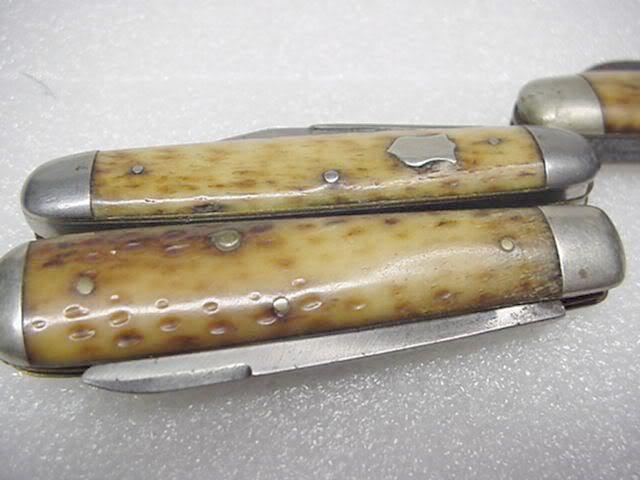
Here is one of the pics posted by morglan that I have noted differences between the two knives side by side.
Oh, one last observation on the shield, the inletting around the shield is considerably larger than the shield itself, especially at the top, and the bottom edge of the shield is roughed up. To me it appears that the shield was not installed in the factory. Yes, I have seen sloppy shield installations from various factories, but not that sloppy from Camillus in that time period.
When I add all of these little things up:
Ø Smooth bone as opposed to jigged
Ø Wrong color
Ø Sloppy install on the shield
Ø Wrong type of lanyard loop
Ø Rounding off from the rear bolster down into the easy open cut out. (All the sharp lines are gone)
Ø The grooved front bolster
Ø The rounding off of the front bolsters
Ø Cracks at the rear pins and at the lanyard hole on both sides as if the pins were peened too hard
When I set back and analyze this knife (or nit-nick if you will) I see far too many things wrong with this knife to think it left the factory anywhere near to the condition we find it in here. Obviously some things could be attributed to wear and use, but there are too many things wrong with the knife for me to buy or sell it as a factory knife that is just worn.
This is an interesting discussion and comparison of the two similar knives. There are too many differences between these knives for me to accept that they are the same model from the same factory from the same time frame, without the one knife being heavily modified.
Perhaps you disagree, that is fine. This is what makes collecting knives and sharing them on AAPK so much fun! I think we can all agree on that!

Whatever the story behind this knife, it is a nice knife and I like it.
I wish it could talk and tell us its story.
Dale








 It is all good buddy!