This forum is dedicated to the discussion and display of old knives. The rich history of all the many companies that made them through the early years will be found here as well as many fine examples of the cutlers art. Share pictures of your old knives and your knowledge here!
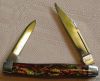
Toothpicks are a neat pattern that you don't find old examples of too often. Here's a "Queen City Titusville PA" of mine.
This knife inspired me to find the truth about celluloid. All real celluloid (aka cellulose nitrate) inevitably will degrade and the process is impossible to stop, but it can be slowed by being stored in a hospitable environment. Celluloid degrades because its molecules crystalize over time and force out another chemical, camphor. This causes the celluloid to become brittle, shrink, and crack. The corrosive byproduct of celluloid breakdown is nitric acid, which is what eats away at the rest of the knife. The process is slowed by:
low humidity
low temperature
air exchange
acid resistant storage case
no UV light exposure
Great info AKC! Cell really does scare me a lot, although I do have a few that I just couldn't resist.Well I don't have an individual pic but here's a shot with my only toothpick in it. Keen Kutter made by Schrade:
on the cutting edge is sometimes not the place to be.
please support our troops - past and present
if not a member...join the NKCA! they're on our side.
Here is a picture of Bulldog's first prototype toothpicks. They are the same knives pictured on the back of the catalog. Notice that the catalog pictures and the 3 knives do not have tang stamps yet.
Notice the Prototype marking - quite rare to have it in print.
Click on the pictures to enlarge them.
As far as celluloid goes I agree 100% with what Another Knife Collector says and I also believe that excess heat when making the knives can accelerate the outgassing process. Heat generated when shaping or buffing are probably 2 big causes. I have a 2 year old knife with waterfall celluloid handles and they stained (and darkened) the bolster and pins. I removed the scales and will put something else on. Only 2 years old!
Attachments
The first Bulldog PROTOTYPE Toothpicks
Notice the Prototype marking - quite rare to have it in print.
I have a pretty nice collection of Tiny toothpick's going....but you all know there are not many made before 1990. Josh Basham from Red Hill Cutlery has over 700 toothpicks....he said he had two of the three original ones including an original christmas tree.......I don't know any thing about vintage toothpicks...but I would love to see his collection!
Here are my two bigger toothpicks! Any of you get one of the pre- WWII - 14 I think Toothpicks off the board in the President of Imperial Schrade's Office? Here is mine called "Carnival" and a green striped Fighting Bulldog I really like.
A good thread for me to celebrate my return to the forum after a short absence. My favorite pattern, in 5" and larger sizes, the Texas toothpick. AKA 'tickler', east st. louis special, 'saturday night special', tango or dance knife, and more other colorful names than any other pattern of knife has been blessed with. The first tactical; I used to have an extra seam sewed into my jeans' back pocket, so I could carry one next to my wallet. Once field dressed a deer with one (so who needs a locking blade for that simple task?). I have one I carry frequently that I put a pocket clip and thumb stud on. BR Levine calls it an all-american pattern, dating from the 1890s. Oldest couple I have are ENTERPRISE and HIBBARD. Largest is a Clayton Graham handmade at 6" closed. I am not a snob; from a couple new made Chinese imports, the Parker and Frost Japan imports of the 1970s, to customs, all have a place in my collection. I'm big on genuine pearl and abalone and abalone cell. Favorites are the very old solid handled Imperial and colonials in wild and crazy cell handles. Best one ever made in production: The Camillus Classic Cartridge #3, with polished bone handles, 7mm mauser blade etches and inert cartridge bottom shield, and grooved bolsters. I keep a few on hand to give to close friends. In one of these photos is the only toothpick ever issued by the US military, a Single bladed emergency fishing knife. It is by Camillus, has a bail on the front bolster, handled in rough black.
I offer you one man's obsession. Been collecting them for many, many years.
Phil
Attachments
Camillus CCC3, never can tell when a knife-less person might visit.
Taking up space in an old Schrade Walden display case. WW2 Emergency Fishing knife is on second shelf, on single stand in the center.
Pearl and Abalone, some Abalone celluloids. Wendell Carson, Bulldog, Parker, Frank Buster, Queen, Blue Grass, and others.
hanging on the wall. Note the two smooth bone parkers that two different scrim artists worked on. A couple classic yellow 'press here' blade lock fishing knives here as well.
hanging on the wall two. A toothpick without a clip blade shown here: AG Russell with leaf shaped blade. To it's left is another AG special, with an extreme clip blade. Second from right is an AG Russell with a neat bolster lock. AG seems to appreciate the tickler pattern.
A box full of ticklers. I have made room for a very few 4 1/4" ticklers as you can see.
Cheap Thornton, the toothpick offers itself as a large canvas for art
thornton toothpick.jpg (36.91 KiB) Viewed 3560 times
Top to bottom: New Schrade China, Schrade Cut Xmas tree, Bulldog stripe, Remington repro bullet 1988, Jim Frost Micarta handle.
Always room for a few of the Toothpick's cousins, the Fishing knife. This one by Camillus
You're up early, Jim. Three AM here in our state of Michigan. Good to 'see' ya. I think I was pretty well smashed when I last saw you, I can't believe a couple dealers actually sold me guns at that show.
About celluloid: I stay away from known maker's whose cell doesn't seem to hold up, like early Frank Busters (Fight'n Rooster). And I only buy those that show no evidence of destruction beginning to take hold. But I don't worry over it. I keep those cells I value most on display, in open air.
Phil
ps... Jonet, I like the Northwoods! Is it a five incher?
hey phil, great collection. yes the northfield is a 5 incher.
here is my camillus fish knife.
Attachments
johnnie f 1949
on the cutting edge is sometimes not the place to be.
please support our troops - past and present
if not a member...join the NKCA! they're on our side.
Phil, I work the midnight shift in the prison so I have some free time on the internet. If you were smashed at the knife show I sure couldn't tell it, I thought you were just camera shy.
Jonet, I will seek out a Northwoods. That Camillus fishknife of yours is a WW2 Emergency fishing knife. All steel liners, right? Brass was rationed and saved for munitions. One of the old surplus outfits bought thousands of unissued ones after the war and sold them with a little piece of paper showing many Camillus wartime knives.
Hukk, I like that you have the paperwork with the knives. I think that adds much to the collection.
Pen, I have been meaning to comment on the source of that old Schrade collection of Imperial Toothpicks, but I don't have all my facts straight yet. For once, I am not going to hammer on the Ebay seller of those items.
Thanks friends for the warm welcome back.
Jim, I didn't want my parole officer aware that I had put my ankle bracelet around my cat's neck and had left town, so no pics.
Pattern Collecting: It allows one to sample the knives of many, many manufacturers and develop a collection with some cohesion. To appreciate the strengths and understand the weaknesses of every brand, in a historical context. Take a look at my old solid handle Imperial toothpicks and then the shell handled ones they later came out with.. and made 10,000 of those things a day. Those sharpies that ran the company recognized a sea change in manufacturing & marketing and moved quick (GM, Ford Chrysler could have taken lessons from them) to position themselves in the market place. Colonial kept pace with them in that strategy. Study an old Queen 'user' toothpick and then look at the new ones made for the showcase. Note the differences and similarities, it being easy (for me, anyway) when the pattern is the same.
Of course my collection doesn't just include Ticklers. But it was a Fight'n Rooster pearl TP that exposed me to the wonders of German made knives (MOP handled ones) from the 70s and 80s and I keep on eye out for any Hickey and Shouse or Hickey and Sons, and others. It was a Schrade Walden Fish knife that led me to the pleasures of collecting that brand. Ever heard of 'Star' knives, imported by a Chattanooga company in the seventies, from Japan? I never paid them any mind until I found a beautiful checkered glitter handled tickler issued by them. I now own one of every model (I think) they ever had made. And it goes on and on and another knife joins the pile...
An old Remington. Toothpicks seem to be hard to come by here on the Coast. As you can see over the decades the bolsters on this one have degraded considerably. The blade is full, Wonder how much stock removal it would take to make it nice and shiny. To me the tang stamp is an anomaly, there are some questions that need to be answered about it. Should anyone know please sound off. AAPK research and my minimal library does not show it. Check out how close the nail nick is to the top of blade.
moss
Please don't polish off that wonderful patina, Moss!!
In seconds you can turn a fantastic knife into just another character-less, shinny(typical spelling) "Tennessee Mint" clunker, with the original grind lines gone!
Shined (correct spelling) up knives are losing value, in the circles I hang out with!
No insult intended to my wonderful friends in Tennessee!!
Utopia!! A chicken in every pot!! And a Barlow in every pocket!!!
Here is a Case serial numbered set, made about 1982. The "80s concept" of green and red bone. Nice, but nothing like the good old stuff!! Glaze finish blades instead of crocus polish. Nice swedges.
Attachments
Utopia!! A chicken in every pot!! And a Barlow in every pocket!!!
Mossdancer wrote:My apologies to your sensibilities Charlie. I should have mentioned tongue in cheek. I think shiny is correct.
moss
Phew, moss! You had me scared for a minute there!
The mis-spelling "shinny" seems to accompany knives that have been cleaned to death! Maybe we should adopt the term?? shinny adjective; 1) denoting "cleaned to death".
2) Indicating few recognizable features.
3) describing magpie bait. *
*Webster's knife dictionary 2008 edition
Utopia!! A chicken in every pot!! And a Barlow in every pocket!!!
inspired to dig em all out - my small but growing tickler collection.
Attachments
johnnie f 1949
on the cutting edge is sometimes not the place to be.
please support our troops - past and present
if not a member...join the NKCA! they're on our side.
I have one just like this... Nail nick in the exact place. Pins seem to be in the right positions. And the handle on MD's looks like mine: rough black. But mine is a straight line remington. I was under the impression that the straight lines were only sold by, not made by, Remington. Anyone know this for a fact? Also, the bolsters on both knives appear to be iron.
It's dangerous and impolite to question the providence of another's knife on most forums, but I will take the plunge and ask if it is possible that the tang was restruck with a phoney circle remington stamp.
Hey Scout;
Long time. I have questioned a knowledgeable collector of Remington's. His words were to the effect that at the conversion from the straight line stamp to the circle straight line stamp with
UMC underneath there were some knives produced with the Straight Line stamp inside the circle. He went on to date these identified knives as more than likely being produced in early 1935. I have had this knife for about 15 years and had never payed attention to the stamp other than to just see it. I am not saying it is an impossibility that the stamped has been as you suggested altered, I can say it does not appear so. And I do know that I have not done anything to it. I am sure the collector of Remington's will be along sooner or later and give a better explanation. I do agree the bolsters are more than likely made from iron.
moss




 Cell really does scare me a lot, although I do have a few that I just couldn't resist.Well I don't have an individual pic but here's a shot with my only toothpick in it. Keen Kutter made by Schrade: