Thank you guys for your input and your kind comments.
I certainly appreciate the feedback. The amber stag is expensive, but everyone seems to like it, including me.
Your critique helps me justify the cost of the amber stag and I will be looking to buy some more of it.
Colonel26 wrote:Top notch again Dale! Fantastic work.
If I may ask a question, for the pins in the stag, do you drill through the tang and pin the scales through the tang, or sonthe pins just go through the stag?
To answer your question Wade, I'm always happy to share tips and techniques with people so they can enjoy the hobby of customizing and repairing knives.
This method applies to a Western knife of the bifurcated tang.
When I have the handle removed and the tang exposed I drill 4 holes for the pens. I center the the holes on each side of the bifurcated tang and move it up or down about 1/4" to 3/8" of an inch from the guard and the pommel.
It is important to drill them before you glue on the stag so that the holes are straight through the metal. If you glue one side of the handle on first before drilling it can cause the drill to veer to one side or another causing the pin holes to be out of alignment with one another or even too close to the edge of the handle material by the time it has gone through the second handle. A little angle at the wrong time can we would mess things up.
I use a jig I made for drilling so that I can clamp tang to the jig and make sure my hole through the first handle is perpendicular. When I glue on the second handle I have to drill down through the first handle, and the tang, before getting into the second strag handle. If everything is perpendicular before the drill enters the second handle oh, there is less tendency for the drill to wander. With 1/16 in drill it is easy for a hard bony piece of stag to bend the drill a little bit off course.
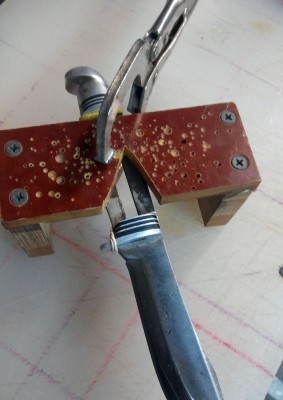
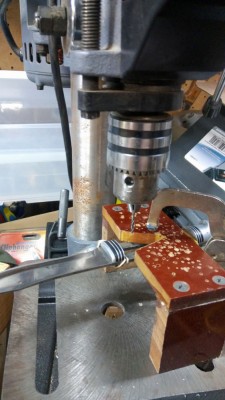
Here are some quick pictures of the jig in the way I would use it. Normally I use the jig when I have one set of handles installed, those would be on the side of the tang facing a four and I would clamp it snug against the jig so that I could drill straight through the existing all in the tang and straight down through the stag. Without the jig the drill tends to wander. The drill that is in the drill press is considerably larger than the #51 drill I used to drill the holes for 1/16th inch pin stock.
Here's a picture of some bifurcated tang Western knives that do not have the handles on them. The top knife in the picture already has the holes drilled in it to install the pins.
Hopefully this will give you an idea of what I'm talking about. If I'm not explaining it will, let me know and I will try tomorrow when I am arrested.
eveled wrote:To answer your implied question. This is how you go wrong with amber stag. This 110 is growing on me and is a good user, but it is not what I thought I was getting. Lol!
Ed, that 110 doesn't look like any of Culpepper's amber stag that I have worked with. When I opened the bag the stag is almost black and and up getting dye all over my hands just from handling it. I can't think of any that I have used that was not colored completely through the stag. Here's a Buck 110 I did in 2008 with amber stag, and this amber stag is lighter than most I recall working with.
It looks to me like you're stag was dyed on the surface and not all the way through it.
I don't know where you're stag came from but it is not typical of the amber stag I have gotten from Culpepper's.