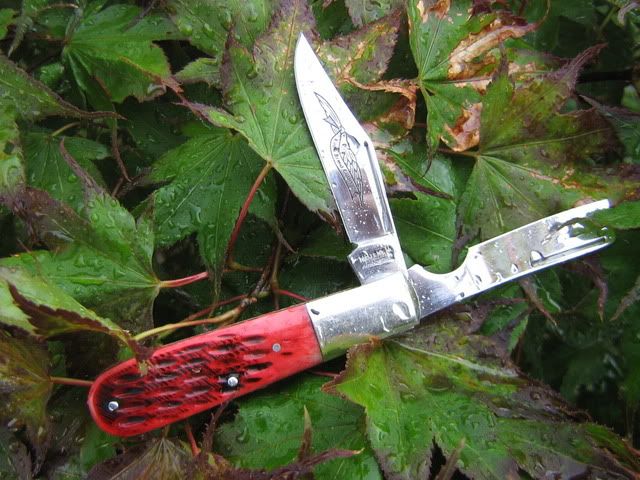
This came up last February. http://www.allaboutpocketknives.com/kni ... ne#p188614 I'm not sure if anything was resolved, but it should make for some good reading. A forum search might show if it's been brought up before that.
Now for my own guess....before jigging machines were around or for the cutlers who couldn't afford them, a fellow would have to pick out small pieces of bone with small, sharp instruments sometimes with the aid of gently tapping on them with a small hammer. I've talked with knifemaker Tony Bose about that very procedure, so I know the practice did exist at one time. So maybe the name pickbone gets thrown around something like Redbone when referring to a Case knife that even shows a hint of red. (?) Maybe anything that we consider jigged was pickbone at one time before the rise of the machines. Pure guess-work here folks....help us out.
At that time I came away empty handed, I really had no better idea of what it was than before the topic started. As for what you mention in your post, well I guess it makes the most sense to me IMO. Here is a knife Circa 1900, which I believe fits your description. Notice the non-directional patterns and Size.
I do remember seeing the word pickbone in "Collector Knives" by Houston Price,Mark Zalesky but can't seem to find it now
At that time I came away empty handed, I really had no better idea of what it was than before the topic started. As for what you mention in your post, well I guess it makes the most sense to me IMO. Here is a knife Circa 1900, which I believe fits your description. Notice the non-directional patterns and Size.
I do remember seeing the word pickbone in "Collector Knives" by Houston Price,Mark Zalesky but can't seem to find it now
Bonehead
I thought this type of hand jigging and the finished product was called scratted bone?
I always wanted to know what pick bone was. Could never could find a definitive answer.
What were guitar picks made of a long time ago? And maybe pick bone has something to do with the way the bone is dyed?
I've seen several old ebony guitar picks and have heard of lignum vitae and ivory ones. Can't see any connection myself, but sometimes the obvious slips right by me. The yellow handles look too random (to me) to have been done by machine, so maybe they would be an example of one type of pickbone. If it is something that was done by hand (totally without jigging machines), wouldn't there be tons of different patterns? From one craftsman to the next, cutlers of the day may have even been able to tell who did the work just by looking at it. This happened in my own job to a degree. There were certain individuals whose work stood out and had certain traits (good or bad depending on who it was). And TripleF, I can assure you that the handles on your knife were done with the aid of a jigging machine. While the company who had it made may well have provided you with a very useable knife at a great price, they have been known to imply things which may not be entirely accurate (Example: your handles aren't pickbone, they're machine jigged). I'm really hoping this thread will draw out some pictures of some really nice old pickbone scales and that someone will come along that knows more than me. Great topic (again)!
I thought I would add these two to the mix because I am wondering if they are pickbone.
Elvis wrote: If it is something that was done by hand (totally without jigging machines), wouldn't there be tons of different patterns? Great topic (again)!
I like your thoughts on this Elvis. There would certainly be differences.
At the same time, one will occasionally see scales like the ones shown by big monk, which to me, seem more like pickbone than any I have seen in this thread, including mine. I hope someone will come up with a definitive answer; but not until we get a lot more pictures.
Big Monk's, Bonehead's and FRJ's knives all have pick bone handles in my opinion. It's important to realize that with pocket wear the bone starts to take on a very different look from the way it looked originally. Big Monk's knife has been extensively pocket worn and so flat areas have developed, isolating the jigs by leaving only the deepest part of the jigging.
The original knife in this thread is not one that I would call pick bone (regardless of what it says on the box) but I guess that someone can print anything they want on a box if they feel it will help to sell a knife, especially with a term so vague as "pick bone". Bonehead's observation of the non-directionality (is that a word?) or randomness of the jigging is spot on, in my opinion.
In response to TripleF's original question of how bone gets to be red, the answer is simple, it's dyed, natural bone is white.
msteele6 wrote:Big Monk's, Bonehead's and FRJ's knives all have pick bone handles in my opinion. It's important to realize that with pocket wear the bone starts to take on a very different look from the way it looked originally. Big Monk's knife has been extensively pocket worn and so flat areas have developed, isolating the jigs by leaving only the deepest part of the jigging.
The original knife in this thread is not one that I would call pick bone (regardless of what it says on the box) but I guess that someone can print anything they want on a box if they feel it will help to sell a knife, especially with a term so vague as "pick bone". Bonehead's observation of the non-directionality (is that a word?) or randomness of the jigging is spot on, in my opinion.
In response to TripleF's original question of how bone gets to be red, the answer is simple, it's dyed, natural bone is white.
msteele6,
Interesting enough the all the knives you mention here are NYKC, Looking closely at FRJ's and the one I show, deep in the valley's it almost appears that a tool could of had a serrated edge on it. Big Monks may have too but it not as easily seen
The cutting edge of the tool appears to be serrated, albiet randomly. I wonder why. What kind of tool was it? What did it look like?
What did the mechanical jigging tool look like?
I often wonder about jigging. I have no idea how it was done.
How about this old Herder? I wonder how it was jigged.
While the definition of pickbone is kinda vague, the pics that Bonehead posted are what I think of when I hear "pickbone".
The first knife that FRJ posted looks similar to E.C. Simmons Keen Kutter jigging to me - just a guess (edit - oh - I just noticed the titles on the pics - I guess one is a Boker and one is Simmons KK). The gouges are too "long" to be pickbone (at least in my mind). The second one - the Herder - sure looks similar to Schrade peachseed jigging.
I would be interested to see any videos of jigging machines if anyone finds a link.
Mike
If you don't watch the news, you are uninformed. If you watch the news, you are misinformed.
Unk wrote:While the definition of pickbone is kinda vague, the pics that Bonehead posted are what I think of when I hear "pickbone".
The first knife that FRJ posted looks similar to E.C. Simmons Keen Kutter jigging to me - just a guess (edit - oh - I just noticed the titles on the pics - I guess one is a Boker and one is Simmons KK). The gouges are too "long" to be pickbone (at least in my mind). The second one - the Herder - sure looks similar to Schrade peachseed jigging.
I would be interested to see any videos of jigging machines if anyone finds a link.
Golly, I'm glad I'm not a betting man. I would have gone to my grave betting that ole Boker was a NYKC. Anyway, I think we need an expert here who is perhaps at least around 90 years old to give us the answers we are looking for. I wish I could go back in time when this knife was being built to see what really happened, and of course ask plenty of questions
bonehead,
that is the very thing that confuses me about knife identification via jigged scales.
Apparently there are guys who can identify knives by looking at the scales. I don't doubt that. Although they can't be 100% accurate. ( I guess not anyway)
As a new guy on the forum I would read posts where folks would surmise or declare one knife or the other as being this brand or that. I was pretty impressed with that and still am. You have to handle a lot of knives to be able to do that with any certainty, but as Bob, aka Elvis, said, when it comes to jigging by hand everyone does it a little bit differently. I guess some operations had a certain look they were after and the men who did the jigging tried to stay with that trend.
I hope some of the big guns see this thread and offer some instruction, and pictures.
By the way, what kind of knife is it that you posted in your pictures of those great looking jigged scales? Thanks.
Has anyone here who does restore work ever tried to reproduce this type of "pick bone pattern" I would think it couldn't be too hard.
I'm sure the old time craftsmen used some sort of small chisel and a hammer to get this affect.
I may just take a crack at it myself.
I do have a thigh bone I found in the forest.
Not too sure what creature it came from. Too big for domestic house cat and too small for a deer. Maybe dog, raccoon, fox or opossum but it is big enough to fit on a small or medium size folder.
Isn't the word jigg or jigging a fairly modern term for a mechanical device that does the job instead of by hand?
Maybe pick bone was the term used before a jigg was invented to do the job faster and more efficient?
I've read that scratted bone was done way before so called Hand jigging and looks more like a saw cut design.
knives-are-quiet wrote:I may just take a crack at it myself.
I do have a thigh bone I found in the forest.
Not too sure what creature it came from. Too big for domestic house cat and too small for a deer. Maybe dog, raccoon, fox or opossum but it is big enough to fit on a small or medium size folder.
knives-are-quiet wrote:Has anyone here who does restore work ever tried to reproduce this type of "pick bone pattern" I would think it couldn't be too hard.
I'm sure the old time craftsmen used some sort of small chisel and a hammer to get this affect.
I may just take a crack at it myself.
J W
Good luck and please let us know how it turns out. I've done a knife or two a few years ago using a small carbide bit in a Dremel and it didn't look half bad (we won't talk about the other half). If you have a Dremel or a Foredom, maybe give it a shot first with different bits and see what you think. I had fun doing it, but it was time consuming enough and the results were nowhere near as nice as what I can order from knifehandles.com.
To tell you the truth, I thought of getting stew meat on the bone at the store and boiling it up and clean the bone and drying it for a good while and putting it in a vice and having a go at it my self. I aint afeard.
I don't believe each slab was done idividually--i would think each piece of bone was run through some sort of set-up and each factory had different chippin or cuttin heads to get the texture they preferred-but i don't think they sat at a bench with a little chisel er what ever and did it
I may be showing my ignorance and over-simplifying the subject , but I think that the term "picked bone" is just another phrase used for "jigged bone" . For the last 40+ years I have heard these terms used interchangeably when referring many different jigging patterns .
I'm with you Bob but i'm thinkin it is just some sort of slang name that got hung on it at one of the factories for a certain job and it stuck wit it over time
robinetn wrote:I may be showing my ignorance and over-simplifying the subject , but I think that the term "picked bone" is just another phrase used for "jigged bone" . For the last 40+ years I have heard these terms used interchangeably when referring many different jigging patterns .
Bob
I'm beginning to agree....the more knives I see, the more I see "jigged" looks like "pick". BUT I've only been looking at knives for the past 7 months.....