


Need help in identifying this 13" knife
-
prober996
- Bronze Tier

- Posts: 166
- Joined: Sun Jan 08, 2023 7:34 pm
- Contact:
Need help in identifying this 13" knife
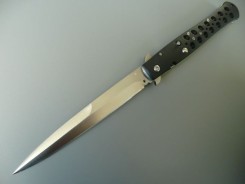
Can anyone help me identify the maker/origin/age of this 13" knife?
-
Killgar
- Posts: 290
- Joined: Mon May 23, 2022 6:28 am
Re: Need help in identifying this 13" knife
Well, it's definitely Italian. But beyond that you'll never know who made it. You have what I call a "mystery Italian" (no brand, no importers mark, no clear indication of who made it). If you don't know already, "INOX" is short for inoxidable, which is another way of saying stainless steel.
It's difficult for me to tell from the pics, but it's possible that you may have what's often referred to as a "transitional". A "transitional" is an Italian stiletto switchblade made from the very late 1950's through to the early 1970's when the Italian makers were changing their manufacturing methods, including switching from pick locks to the easier to operate swivel-bolster.
Your knife looks to me to be closer to the 1970's than the 1950's. The handles are horn.
Common characteristics of a "transitional" are-
nickel silver bolsters and button (as opposed to steel)
swedge blade (full flat grind with a hint of a false edge)
two-piece spring (but not always)
D-stamped liners (pics below)
It looks to me like your knife has a one-piece spring (the kick spring is the same piece of steel as the backspring/lock). So that's one point against it being a "transitional".
But if your knife has D-stamped liners like in the pics below, then there's a better chance that it's a "transitional". I'd say the bolsters and button would then be the deciding factor- what are they made of. Trying to determine that can be tricky. If they are magnetic, then they are stainless steel (not a "transitional"), but not all stainless steel is magnetic, so there's the problem. The rocker arm of a "transitional" will be steel, so if you apply a magnet to the button, even if it's nickel silver, the steel rocker underneath might still attract the magnet.
Again, a "mystery Italian", which is not at all uncommon. Unfortunately the people who produced such knives, and those who purchased them for resale, didn't always care about recognition or posterity. They just wanted the money.
The blue arrow in the first pic points to one of the D-stamp cutouts in the liner. If you look between the liners of your knife, you should see if the liner has the D stamped cutout.
Here's another view of D-stamped liners showing how they hold the sear/rocker arm in place.
It's difficult for me to tell from the pics, but it's possible that you may have what's often referred to as a "transitional". A "transitional" is an Italian stiletto switchblade made from the very late 1950's through to the early 1970's when the Italian makers were changing their manufacturing methods, including switching from pick locks to the easier to operate swivel-bolster.
Your knife looks to me to be closer to the 1970's than the 1950's. The handles are horn.
Common characteristics of a "transitional" are-
nickel silver bolsters and button (as opposed to steel)
swedge blade (full flat grind with a hint of a false edge)
two-piece spring (but not always)
D-stamped liners (pics below)
It looks to me like your knife has a one-piece spring (the kick spring is the same piece of steel as the backspring/lock). So that's one point against it being a "transitional".
But if your knife has D-stamped liners like in the pics below, then there's a better chance that it's a "transitional". I'd say the bolsters and button would then be the deciding factor- what are they made of. Trying to determine that can be tricky. If they are magnetic, then they are stainless steel (not a "transitional"), but not all stainless steel is magnetic, so there's the problem. The rocker arm of a "transitional" will be steel, so if you apply a magnet to the button, even if it's nickel silver, the steel rocker underneath might still attract the magnet.
Again, a "mystery Italian", which is not at all uncommon. Unfortunately the people who produced such knives, and those who purchased them for resale, didn't always care about recognition or posterity. They just wanted the money.
The blue arrow in the first pic points to one of the D-stamp cutouts in the liner. If you look between the liners of your knife, you should see if the liner has the D stamped cutout.
- d stamp liner.jpg (45.14 KiB) Viewed 4029 times
Here's another view of D-stamped liners showing how they hold the sear/rocker arm in place.
- D stamped liners-sear-rocker.jpg (65.03 KiB) Viewed 4029 times
Avatar- Ti-lite auto conversion. Video- https://www.youtube.com/watch?v=q79nia-_DzU
My Youtube knife channel- https://www.youtube.com/@killgar2621/videos
My Youtube knife channel- https://www.youtube.com/@killgar2621/videos
-
Bill DeShivs

- Silver Tier

- Posts: 925
- Joined: Sun Oct 07, 2012 4:57 am
- Contact:
Re: Need help in identifying this 13" knife
The high button on a 13" knife is indicative of it having a modern button assembly. From the pictures, I would say the bolsters are steel. The swivel bolster is unlined.
Strangely, it appears the bolsters (except the swivel) are soldered to the liners.
Strangely, it appears the bolsters (except the swivel) are soldered to the liners.
Bill DeShivs, Master Cutler
Factory authorized repair for:
Latama
Mauro Mario
LePre
Colonial
KABAR
Hubertus, Grafrath, Ritter
Schrade Cut. Co., Geo Schrade, Pressbutton, Flylock
Falcon/AKC/AGA Campolin
Puma
Burrell Cutlery
Factory authorized repair for:
Latama
Mauro Mario
LePre
Colonial
KABAR
Hubertus, Grafrath, Ritter
Schrade Cut. Co., Geo Schrade, Pressbutton, Flylock
Falcon/AKC/AGA Campolin
Puma
Burrell Cutlery
-
prober996
- Bronze Tier
- Posts: 166
- Joined: Sun Jan 08, 2023 7:34 pm
- Contact:
Re: Need help in identifying this 13" knife
Killgar and Bill, thanks for the bounty of information. I now have some things to explore tonight when I get home for m the office.
-
CountryBoy77
- Posts: 76
- Joined: Sat Mar 01, 2025 2:52 am
Re: Need help in identifying this 13" knife
Early 80s knife.Exactly like one of my first.Quality knife.Even in the 80s the knives comming out of italy were of different qualitys from different makers.Nice example of one of tge original modern mechànism swivel bolster. Marks an era of its own.