


1894 Oskar Molin started a small cutlery, very small, in Nyfors outside Eskilstuna in Sweden. After a couple of years Severin, his son, started to work along with him, at first as an apprentice. It is said that an apprentice att Molins at least had to do about 15 years of apprenticeship to reach the skills that allowed him to put his firstname or his initials on a production Molinknife. 1934 Severins son Karl, the third generation began to work at Molins. He was the last cutler in the familybuisiness and struggled with the company several decades after the cut-throat competition from Asia had made most of the Swedish cutlerys unprofitable, except the biggest. In the 1930´s there were about 30 cutlerys in the vicinity of Eskilstuna that made pocketknives, nowadays it remains one, I think. Molins was one of the last of the small independents. They, or at least Karl, worked 7 days a week, 80 hours each week, holiday only on christmasday and easterday and one day at midsummer, to make a living out of it.
One could think that a man like him had a lot of knives. But when the day came for closing up the shop of the Molin cutlery for good he had sold out everything. He kept _one single knife as a memory of the familycutlery which at least themselves considered to produce one of the best of the best of knives. A place where almost everything on the knife were made from scratch of the man whose name was stamped on the blade, except from the material on the handle then...
There are three names on the knives that occures:. Oskar Molin, Severin Molin and Karl Molin.
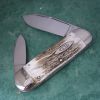
This one is a Severin Molin (S. Molin). Bought new in a hardwarestore by a farmer at the southeastcoast of Sweden somewhere in the 1920`s. (It was said it was in the beginning of the 1900¨s but I take me the liberty to assume it is made about 1920 or perhaps even in the beginning of the thirtys, somewhere in between there.. There is no way I know of to date them exact. It measures 90 millimeter, 9 centimeter and 16 vith the blade. (One inch is 25,4 millimeter.) It´s in good condition.
No fancy looks or expensive handlematerial perhaps, (I´m told the material was called Black Merlin then, "svart merlin in swedish, surely think its bakelite? never heard the expression black merlin anywhere else. Please inform me if you have) but in my eyes this one is emanating an amosphere of an eagerness to be used and a promise of being a reliable and loyal companion on the journey.
I really like it,
so here it is:
Molin cutlery, Sweden.
-
Bulldog-Arne

- Posts: 108
- Joined: Wed Feb 06, 2008 8:20 pm
Molin cutlery, Sweden.
- Attachments
-
- molin3.jpg (85.9 KiB) Viewed 4516 times
-
- molin2.jpg (88.82 KiB) Viewed 4517 times
-
- molin11.jpg (75.5 KiB) Viewed 4527 times
-
- molin44.jpg (60.55 KiB) Viewed 4527 times
-
Classic Case
- Posts: 1225
- Joined: Fri Feb 16, 2007 11:15 pm
- Location: MI
 looks like a well built knife. Also, thanks for the history lesson.

-
Bulldog-Arne
- Posts: 108
- Joined: Wed Feb 06, 2008 8:20 pm

-
Gunsmoke47
- Gold Tier

- Posts: 1921
- Joined: Fri Mar 09, 2007 10:41 pm
- Location: Texas Panhandle
-
Ringmaster

- Posts: 498
- Joined: Wed Jul 11, 2007 9:59 pm
- Location: Arkansas
Hi Bulldog-Arne,
Nice old knife, for sure ! And, a great story, too.
One test, not completely conclusive, for bakelite is to rub the handles vigorously with a polishing paste such as Simichrome. The handles will remain shiny black, of course, but the polishing rag will normally show a brown color.
It also has a very distinct odor when heated, but you wouldn't want to do that to your knife, of course.
That's about all the help I can be,
JR
Nice old knife, for sure ! And, a great story, too.
One test, not completely conclusive, for bakelite is to rub the handles vigorously with a polishing paste such as Simichrome. The handles will remain shiny black, of course, but the polishing rag will normally show a brown color.
It also has a very distinct odor when heated, but you wouldn't want to do that to your knife, of course.
That's about all the help I can be,
JR
"A knife without a blade, for which the handle is missing."
"Buy more ammo" - Johnnie Fain.
"Buy more ammo" - Johnnie Fain.
-
Bulldog-Arne
- Posts: 108
- Joined: Wed Feb 06, 2008 8:20 pm
Thanks for the tip, Ive made that experiment now.
We dont have Simichrome here, but Im told Autosol is the exact same product with another name. so I used that-
The result:
At first when polishing with Autosol on the rag it gave a blueish/darkgrey color on the rag. Not much but some at first. When continued afterpolishing there came no more color on the rag.
We dont have Simichrome here, but Im told Autosol is the exact same product with another name. so I used that-
The result:
At first when polishing with Autosol on the rag it gave a blueish/darkgrey color on the rag. Not much but some at first. When continued afterpolishing there came no more color on the rag.
-
Ringmaster
- Posts: 498
- Joined: Wed Jul 11, 2007 9:59 pm
- Location: Arkansas
Well pal, you've got me...
When I was fooling around with antique radio's, I would polish them with Simichrome, and it always came off brown, despite whatever color the bakelite was.
It'd be fun to know what the stuff is made of, tho'. I dunno exactly when paper Micarta came along, but I THINK it was after that knife was built ?
Good luck,
JR
When I was fooling around with antique radio's, I would polish them with Simichrome, and it always came off brown, despite whatever color the bakelite was.
It'd be fun to know what the stuff is made of, tho'. I dunno exactly when paper Micarta came along, but I THINK it was after that knife was built ?
Good luck,
JR
"A knife without a blade, for which the handle is missing."
"Buy more ammo" - Johnnie Fain.
"Buy more ammo" - Johnnie Fain.
-
Bulldog-Arne
- Posts: 108
- Joined: Wed Feb 06, 2008 8:20 pm
Micarta... I think you said something there.
Googled to see when about it first appeared on the market, this is what Wikipedia says:
"A composite of linen or paper fabric in a thermosetting plastic originally used in electrical and decorative applications. Micarta was developed by George Westinghouse at least as early as 1910"
and another site from a manufacturer, dont remember which:
""Micarta is a trade name that was given to thermoset composites back in the 1890’s by Westinghouse."
It could be a good guess.
Googled to see when about it first appeared on the market, this is what Wikipedia says:
"A composite of linen or paper fabric in a thermosetting plastic originally used in electrical and decorative applications. Micarta was developed by George Westinghouse at least as early as 1910"
and another site from a manufacturer, dont remember which:
""Micarta is a trade name that was given to thermoset composites back in the 1890’s by Westinghouse."
It could be a good guess.