Page 1 of 2
Not a knife but interesting
Posted: Thu Mar 28, 2019 2:10 pm
by petesknives
Picked this up at a yard sale. Had to have it for 10 bucks. My neighbor said that it's a hay saw. Is he correct?
Re: Not a knife but interesting
Posted: Thu Mar 28, 2019 2:22 pm
by Gunsil
He is correct!!
Re: Not a knife but interesting
Posted: Thu Mar 28, 2019 2:39 pm
by petesknives
For sawing hay bales?
Re: Not a knife but interesting
Posted: Thu Mar 28, 2019 2:51 pm
by Steve Warden
Hay knife
From Wikipedia, the free encyclopedia
A hay knife is an agricultural hand tool: a long-bladed knife which has large rounded serrations on the edge, used for sawing off sections at the end of a bale, stack or compact pile of hay. In the south of England hay knives have smooth edges
Re: Not a knife but interesting
Posted: Thu Mar 28, 2019 3:09 pm
by orvet
I'm not old enough to remember putting up loose but the ranch I worked on as a kid, our neighbors ranch, had put up loose hay until after WW II, when balers became more common.
When you stack tons and tons of hay in a barn the weight of it almost makes it a giant bale. You don't move a lot of loose hay easily. Most of the old ranches around our area had a big hay fork which was rigged up on a pulley system it would take a big bite out of the top of a pile of hay then swing over to the opening at the top of the barn so you can let this big fork of hay down into the wagon. Which then hauls the hay out to the cattle.
The hay gets packed so tightly by its own weight that the only place to access it it's from the top of the pile, which when the barn is first filled is quite a climb up to the top.
If you need to access the hay to feed animals you have in stalls around the barn, you don't want to have to climb to the top of the pile to give them hay, this is where the hay saw comes in. You can cut into the hay at the bottom of the pile and get some out for your animals that are in the stalls around the bottom of the barn. Also there are usually passageways and rooms around the bottom of the barn and sometimes the hay spills over and blocks access to them and it is helpful to have the hay saw open up those areas.
The hay saw works well cutting the strings a bail of hay, but they were really designed to cut the hay itself when it's in a big huge pile.
Re: Not a knife but interesting
Posted: Thu Mar 28, 2019 5:23 pm
by tongueriver
Good info, Dale! I was in on more hay processing than I care to remember in my youth. We did not have a barn with loose hay in the top story like was more common at one time. We (in the 1950s and 1960s) had small squared bales in outside stacks. I never saw one of those tools. I hope I never have the occasion to touch hay again in my life.
Re: Not a knife but interesting
Posted: Thu Mar 28, 2019 5:28 pm
by peanut740
It is for sawing loose hay piled and packed in a barn loft.I own a couple barns that still have the track in the top to transport loose hay into and out of the barn.
Re: Not a knife but interesting
Posted: Thu Mar 28, 2019 6:06 pm
by Colonel26
I never got to use one of those either. Although, I have sling my fair share of square baled hay. My barn has a hay loft for square bales, but no track or fork for loose hay.
Re: Not a knife but interesting
Posted: Thu Mar 28, 2019 6:13 pm
by New_Windsor_NY
The hay knife with serrated steel blade and two wooden handles. Before hay was baled it was harvested long and placed in hay stacks, or it was lifted up into barn lofts with slings or forks. When this loose hay settled it was very difficult to remove from the stack. The hay knife was used to cut off small portions of hay that could then be fed to the cows. The knife had two handles, both on the same side, so that one could work close to the face of the stack without hitting his hands. The design for this style of hay knife was patented by George Weymouth of Dresden, Maine on March 7, 1871. The patent was reissued in 1882 and 1886 and both of those patents were assigned to Hiram Holt. His company, The Hiram Holt Company of East Wilton, Maine, sold them using the name of the Lightning Hay Knife. The cost for a Lightning Hay Knife was 50 cents in the 1897 Sears and Roebuck catalog.
Re: Not a knife but interesting
Posted: Thu Mar 28, 2019 6:21 pm
by orvet
tongueriver wrote:Good info, Dale! I was in on more hay processing than I care to remember in my youth. We did not have a barn with loose hay in the top story like was more common at one time. We (in the 1950s and 1960s) had small squared bales in outside stacks. I never saw one of those tools. I hope I never have the occasion to touch hay again in my life.
I never had to take part in harvesting loose hay, I cut the hay, I raked the hay, I stacked the bales in the barn. We used to use a conveyor to run the bales up to the hayloft, and I have fed the conveyor and I have stacked it in the barn. The only thing I didn't do was run the baler because it was pulled by a small Caterpillar I didn't know how to drive. Besides, Henry, the owner, had to have something to do!
I started working on the ranch in 1962 which was probably a good 15 years after they had harvested in the loose hay. Southern Oregon, especially the Dead Indian Road area is known for having plenty of rattlesnakes. Henry said when they used to bring the loose hay into the barn, it would be in the fields in shocks. The shocks are basically large piles of hay that they would turn every once in a while to allow them to dry out for putting it in the barn.
Note for those who have never worked in the hay fields: – WET HAY WILL BURN! The pressure of the weight of the pile causes heat at the bottom and it will actually spontaneously combust if you put wet hay in your barn.
Henry said when it came time to bring the shocks out of the field and the barn it took a crew of about six men plus the guy driving the wagon. Three of the men were pitching hay onto the wagon and the other three men were killing rattlesnakes.
Now days, picking up shocks of hay in those conditions would be a good exercise in team-building! You would definitely have to trust the guy next to you if you had the pitchfork and were throwing hay and the guy next to you was the one killing snakes.
If that could be incorporated into some of these big corporations management training seminars; companies would pay thousands of dollars to have their executives go to that kind of Team Building Training!

Re: Not a knife but interesting
Posted: Thu Mar 28, 2019 6:45 pm
by OLDE CUTLER
I have seen pictures from back in the day before refrigeration when workman would use saws that looked a lot like that to cut ice blocks from the river during winter months to store in the "icehouse" for distribution during warm weather. How would those ice saws differ from the one shown? Maybe they had different teeth to cut ice more efficiently?
Re: Not a knife but interesting
Posted: Thu Mar 28, 2019 8:59 pm
by treefarmer
Olde Cutler, that was my 1st thought, an ice saw. I know absolutely nothing about ice saws or hay saws but I have to admit I know way more than I should about the hay business. Starting at about 14 years old till we got out of the cow business 20 years ago. Cut, rake, bail, load on truck, unload in barn, load on truck again, haul to pasture, get out of truck while it is crawling along in granny low, climb up in the back, use knife to cut hay strings, kick the wafers of hay off the back of the truck as it crawls across the pasture, when finished, jump down run back to cab of truck and head back to the house. All of this except the cut, rake and bail, was an every day job when the weather got cold enough to kill the grass. Some times we did grass hay and sometimes we did peanut hay.
I was glad when we started buying round bails and sadly my hay business partner passed away about the same time.

Treefarmer
Re: Not a knife but interesting
Posted: Thu Mar 28, 2019 9:04 pm
by Colonel26
orvet wrote:tongueriver wrote:Good info, Dale! I was in on more hay processing than I care to remember in my youth. We did not have a barn with loose hay in the top story like was more common at one time. We (in the 1950s and 1960s) had small squared bales in outside stacks. I never saw one of those tools. I hope I never have the occasion to touch hay again in my life.
I never had to take part in harvesting loose hay, I cut the hay, I raked the hay, I stacked the bales in the barn. We used to use a conveyor to run the bales up to the hayloft, and I have fed the conveyor and I have stacked it in the barn. The only thing I didn't do was run the baler because it was pulled by a small Caterpillar I didn't know how to drive. Besides, Henry, the owner, had to have something to do!
I started working on the ranch in 1962 which was probably a good 15 years after they had harvested in the loose hay. Southern Oregon, especially the Dead Indian Road area is known for having plenty of rattlesnakes. Henry said when they used to bring the loose hay into the barn, it would be in the fields in shocks. The shocks are basically large piles of hay that they would turn every once in a while to allow them to dry out for putting it in the barn.
Note for those who have never worked in the hay fields: – WET HAY WILL BURN! The pressure of the weight of the pile causes heat at the bottom and it will actually spontaneously combust if you put wet hay in your barn.
Henry said when it came time to bring the shocks out of the field and the barn it took a crew of about six men plus the guy driving the wagon. Three of the men were pitching hay onto the wagon and the other three men were killing rattlesnakes.
Now days, picking up shocks of hay in those conditions would be a good exercise in team-building! You would definitely have to trust the guy next to you if you had the pitchfork and were throwing hay and the guy next to you was the one killing snakes.
If that could be incorporated into some of these big corporations management training seminars; companies would pay thousands of dollars to have their executives go to that kind of Team Building Training!
+1 on the hay spontaneously combusting. In my area alfalfa is the worst. There was a barn not far from me that caught fire and burned this last fall from the alfalfa. We’ve had an extremely wet year. The guy did everything like he always had for years. But it just wasn’t enough this year and up in flames she went.
Re: Not a knife but interesting
Posted: Thu Mar 28, 2019 9:11 pm
by OLDE CUTLER
treefarmer wrote:Olde Cutler, that was my 1st thought, an ice saw. I know absolutely nothing about ice saws or hay saws but I have to admit I know way more than I should about the hay business. Starting at about 14 years old till we got out of the cow business 20 years ago. Cut, rake, bail, load on truck, unload in barn, load on truck again, haul to pasture, get out of truck while it is crawling along in granny low, climb up in the back, use knife to cut hay strings, kick the wafers of hay off the back of the truck as it crawls across the pasture, when finished, jump down run back to cab of truck and head back to the house. All of this except the cut, rake and bail, was an every day job when the weather got cold enough to kill the grass. Some times we did grass hay and sometimes we did peanut hay.
I was glad when we started buying round bails and sadly my hay business partner passed away about the same time.
Treefarmer
In the vintage pictures I have seen, the ice saws had a double handle setup very much like the original post picture. What cannot be seen clearly is the teeth, which are down into the ice.
Re: Not a knife but interesting
Posted: Thu Mar 28, 2019 9:57 pm
by petesknives
Wow thanks for all your information. .that's why this site is the best!!
Re: Not a knife but interesting
Posted: Thu Mar 28, 2019 10:20 pm
by peanut740
Never worked in loose hay,but dad and grandpa did.We had modernized by the time I came along. There were several years we square baled 20000+ bales.The year I graduated high school in 1978,I bought a round baler.
Re: Not a knife but interesting
Posted: Thu Mar 28, 2019 11:12 pm
by FRJ
OLDE CUTLER wrote:I have seen pictures from back in the day before refrigeration when workman would use saws that looked a lot like that to cut ice blocks from the river during winter months to store in the "icehouse" for distribution during warm weather. How would those ice saws differ from the one shown? Maybe they had different teeth to cut ice more efficiently?
OLDE CUTLER, check out this thread. I show an old Ice Saw six post down from the start.
viewtopic.php?f=42&t=38018
Re: Not a knife but interesting
Posted: Thu Mar 28, 2019 11:44 pm
by ken98k
I did lots of haying when I was a kid. At first the bales where dropped in the field and we had to throw them onto a hay wagon where it was stacked for the ride back to the barn. Later on, the baler had a kicker that tossed the bales into a wagon which greatly cut down on physical labor.
Back at the barn, the bales were loaded onto a conveyor which was adjustable as to where the bales were kicked off and then we stacked it.
None of the jobs was any fun with the exception of pulling the wagons back and forth from barn to hay field. (I never got that job)
Working in the haymow was the worse as it was mercilessly hot up there. As I recall, It seemed to take a long time for the scars and scratches on my forearms to go away each year.
Re: Not a knife but interesting
Posted: Fri Mar 29, 2019 12:40 am
by Dinadan
This is a very informative thread! Thanks for the info, Dale. Like some others, in my youth I participated in loading and stacking hay bales, but I have never even seen loose hay being stored.
Re: Not a knife but interesting
Posted: Fri Mar 29, 2019 3:29 am
by Mumbleypeg
I suspect there may still be some of those in use in Europe, as you can still see stacks of loose hay on some farms there.
I never worked with loose hay myself. Starting when I was a young teenager I worked putting up hay (square bales). We didn’t have any conveyers or machinery other than cutters, rakes and balers. Square bales weighing 60 to 80 lbs were loaded from the field into trucks, carried to the barn, thrown (“bucked”) up into the loft and stacked, all by hand. Alfalfa was typically the heaviest - fortunately there’s not a lot of it around here.

We bailed by day, and stacked by night when it was cooler. Still a hot, dusty, sweaty job - stacking in the loft (where there was no breeze and a lot of dust) was the worst job. But you’d be in good shape for football season!

I remember when I was about 14 years old getting paid 1-and-a-half cents a bail.

We square baled some here on the ranch into the mid-1990s because we had a market for the square bales with horse people. Many were women and kids who wanted square bales because they could handle them. If they were too heavy they didn’t want them because they couldn’t handle them, so we baled them to weigh no more than 40-50 lbs. We stored them in the loft of our old barn until sold.
Everything now is round bales and the loft has sat empty for about 25 years. And I stopped delivering a few years ago. You want to buy hay, come get it. I’ll load it on your trailer with a tractor.
Ken
Re: Not a knife but interesting
Posted: Fri Mar 29, 2019 6:35 am
by royal0014
Fortunately I never had to bail hay .....
But as a former volunteer fire-person I can attest to wet hay spontaneously combusting.
Gets hot as the dickens, too. Pretty much just have to try and contain the flames and let it burn.
Re: Not a knife but interesting
Posted: Fri Mar 29, 2019 6:51 am
by orvet
ken98k wrote:I did lots of haying when I was a kid. At first the bales where dropped in the field and we had to throw them onto a hay wagon where it was stacked for the ride back to the barn. Later on, the baler had a kicker that tossed the bales into a wagon which greatly cut down on physical labor.
Back at the barn, the bales were loaded onto a conveyor which was adjustable as to where the bales were kicked off and then we stacked it.
None of the jobs was any fun with the exception of pulling the wagons back and forth from barn to hay field. (I never got that job)
Working in the haymow was the worse as it was mercilessly hot up there. As I recall, It seemed to take a long time for the scars and scratches on my forearms to go away each year.
Your experience are very similar to mine Ken, we used trucks instead of wagons and we also used a wooden sled which were nice because we didn't have to buck the bales so high to get them on the sled. Since the sled sat right on the ground we could just slide the first row on and an stack on top of that. The fields of that time of year were so dry and that the sled was about all we used at the upper ranch. If we had to drive the hay all the way down to the lower ranch we loaded on the truck. That was about 5 miles a really bad road and that's where I learned to drive a truck. You did good if you made it all the way down the mountain to the lower ranch without losing any bales. The road we were driving on wasn't even as good as a logging road. It was great adventure for a 12 and 13 years old! By the time I was 14 or 15 it was pretty much routine.

Ken, you are mentioned scars and scratches on the forearms. I don't know where you were hauling hay, but in Southern Oregon we have this nasty little plant called a star thistle and they are about the worst thing you can put in a bale of hay! That would leave your forearms full of holes and scratches and even worse when you used your leg to boost the bail up so you didn't have to get so many stickers in your forearms, those long thorns would go in your legs. Henry owned the ranch I worked on and he was usually out in the field helping, sometimes it was just he and I. We were doing a lower field that he had cut for someone else and the star thistle's were terrible but year. He actually said were going to leave the rest of this because it's not even worth bucking. When we left our forearms look like they had been through a meat grinder, and as I remember I had enough holes poked in my legs that the thighs of my jeans were red.
For those of you who don't know what star thistles are, say hello to my little friend!
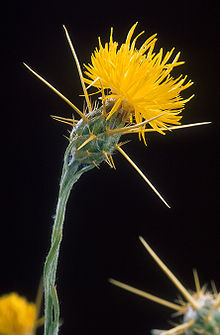
- Yellow star thistle.jpg (17.76 KiB) Viewed 1517 times
They are even worse than they look! I'm not sure if there was any toxin in the thorns but they sure did burn when they stuck you!

Re: Not a knife but interesting
Posted: Fri Mar 29, 2019 10:21 am
by Colonel26
That’s a nasty looking thistle!
Here, there’s still a few Amish that lit up loosenhay in a mow. But not many. Most cut it themselves with horses and hire it baled.
Re: Not a knife but interesting
Posted: Fri Mar 29, 2019 1:04 pm
by tongueriver
There is one big difference in the hay business in my area and much of the rest of the U.S. Water. Humidity and rainfall. We are in the semi-arid to arid Rocky Mountain West, where precipitation is very low, and the same with humidity. Therefore, there is no need here for the giant barns and other protections to keep hay dry. It is all stored outside. Occasionally an outfit with more money than usual will put up a pole shelter or buy big tarps to go over stacks of square bales or rows of round bales. Even back in the 1950s I don't recall ever seeing loose hay. I raked plenty of it and helped bale and so on. Saw my share of rattlesnakes. I whacked one once with a 'crescent' wrench. What was I thinking?
Re: Not a knife but interesting
Posted: Fri Mar 29, 2019 6:15 pm
by OLDE CUTLER
FRJ wrote:OLDE CUTLER wrote:I have seen pictures from back in the day before refrigeration when workman would use saws that looked a lot like that to cut ice blocks from the river during winter months to store in the "icehouse" for distribution during warm weather. How would those ice saws differ from the one shown? Maybe they had different teeth to cut ice more efficiently?
OLDE CUTLER, check out this thread. I show an old Ice Saw six post down from the start.
viewtopic.php?f=42&t=38018
Those teeth on the ice saw are much different. One time when I was out in a local antique mall, I saw an old saw hanging up on the wall for sale. It was a two man saw for cutting trees as it had handles on both ends. As I was standing there a young couple happened to walk by and the girl asked the guy what the saw was for. He replied "Oh, that is an ice saw for cutting ice blocks from the river". I silently laughed as I tried to picture the guy on the bottom handle of the saw in scuba gear. lol