Page 1 of 1
WW1 Simmons Keen Cutter Clasp Knife Mystery!!
Posted: Mon Sep 02, 2013 1:56 pm
by dutchy357
Hi Guys
Here is a knife that I added to my collection recently.
This clasp knife really has me puzzled.
This one has been a real roller coaster of emotions since it arrived.
When I purchased it, I thought it was a WW1 9402/1917 pattern “Knives, Clasp with Tin Opener and Marline Spike with Fibre Scales”. This was one of the series of knives produced during WW1 that had only the blade and tin opener and were shorter by about 5/8" than the 6353/1905 and its variants.
On first examining the knife, I realised that it was a larger knife and was the same size as the 6353/1905. My heart sank, because I thought it must be a 6353/1905 pattern that had the marline spike removed.

I was shocked at such a travesty as this would have been a much scarcer variant with jigged fibre scales.
Further examination revealed that this was not the case. The ends of the springs at the shackle end of the knife are the same as the smaller series of knives. This clearly establishes that this knife was made this way.

I then also realised that this was a US made knife as it is marked Simmons Keen Kutter St Louis. I have seen other examples of US made 6353/1905 pattern knives. So being US made was not a complete surprise but was unexpected!
So what have I got here??
It is defintely a 6353/1905 pattern produced with only a blade and tin opener.
During WW1 when the British also issued the smaller clasp knife with blade and tin opener, was this an American version of this knife?
The images below show the knife .
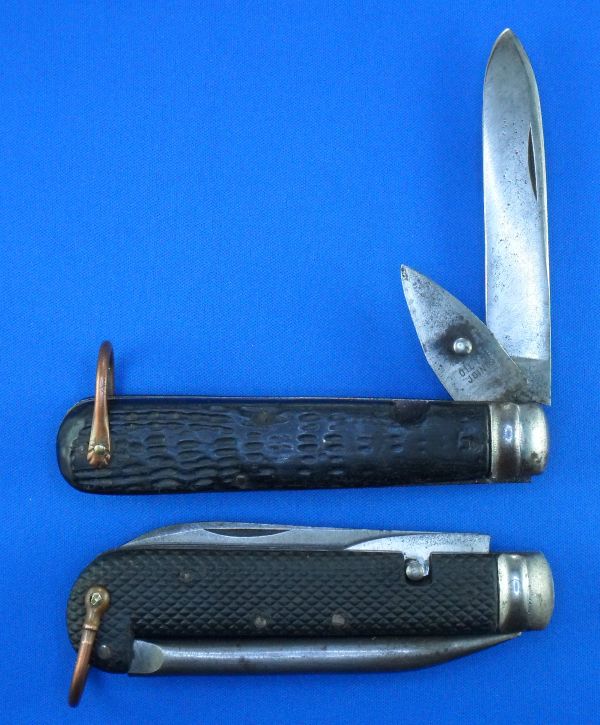
Compared alongside a 6353/1905
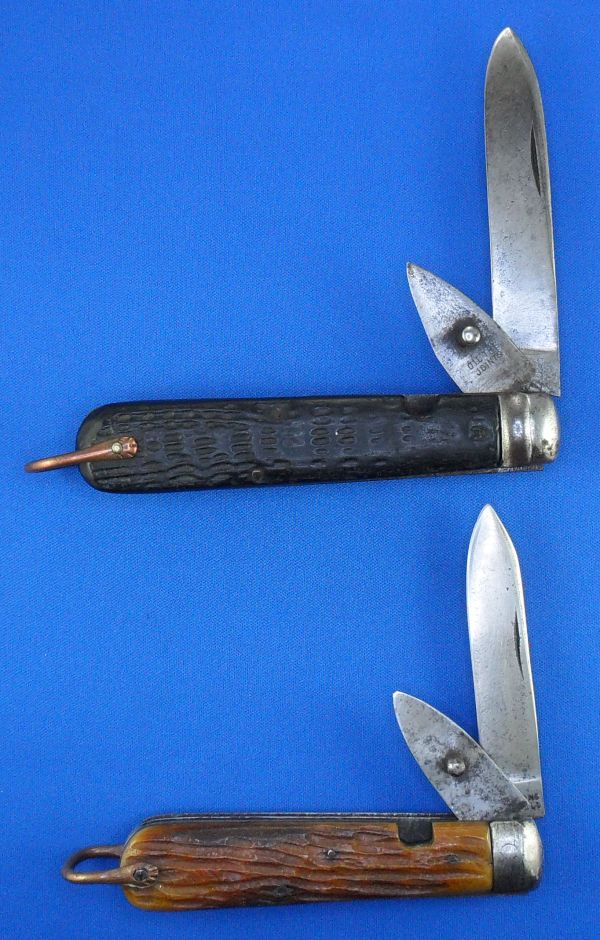
Compared against an 8173/1914
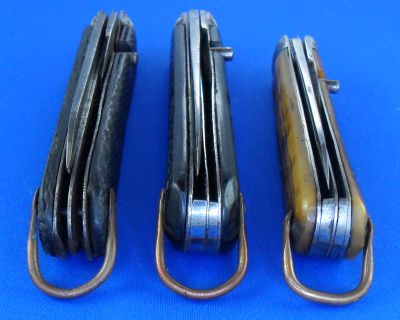
This image shows the shackle end of the knife. The knife on the LH side is a 6353/1905 that has had the marline spike removed. You can clearly see that it still has provision for the spike to hinge and rotate back. The Centre knife is the Keen Kutter mystery knife. You can clearly see that there is no provision for a marline spike. The RHS knife is the 8173/1915 featured in the previous image. Again, this knife does not have a marline spike or provision for one!
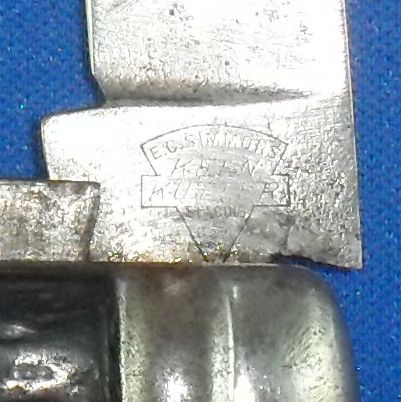
Keen Kutter makers mark
I hope you find this knife of interest and I am very interested to hear everyones comments on it.
I have asked about this knife in other forums and have not found out very much at all. I have found two similar examples but no one can provide me with much information.
Where does it fit in the Lexicon of knife history??
I would be grateful for any information.
Regards Dutchy
Re: WW1 Simmons Keen Cutter Clasp Knife Mystery!!
Posted: Mon Sep 02, 2013 2:15 pm
by Miller Bro's
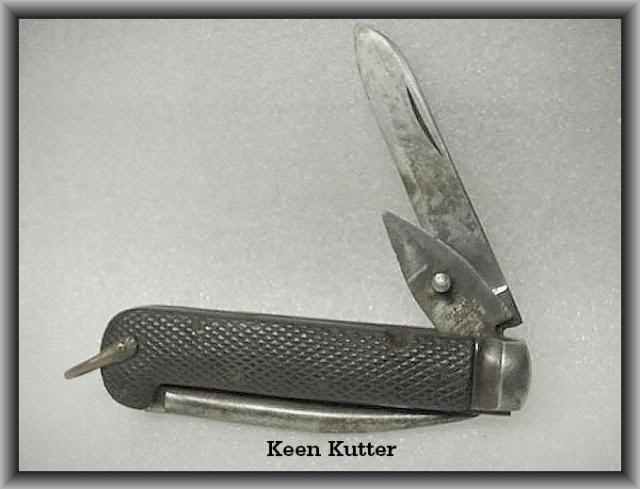
Here is the one I have, they were made by several U.S. makers.
I believe they were sold to the Canadian military during WWI.
Re: WW1 Simmons Keen Cutter Clasp Knife Mystery!!
Posted: Fri Sep 06, 2013 12:52 am
by dutchy357
Miller Bro`s wrote:Here is the one I have, they were made by several U.S. makers.
I believe they were sold to the Canadian military during WWI.
Hi Miller Bro's
Thank you! Thats 3 other examples I am aware of.
Mine does not have a Canadian acceptance mark. Does yours?
Regards Dutchy
Re: WW1 Simmons Keen Cutter Clasp Knife Mystery!!
Posted: Fri Sep 06, 2013 1:04 am
by Miller Bro's
dutchy357 wrote:Mine does not have a Canadian acceptance mark. Does yours?
I will have to check and get back to you

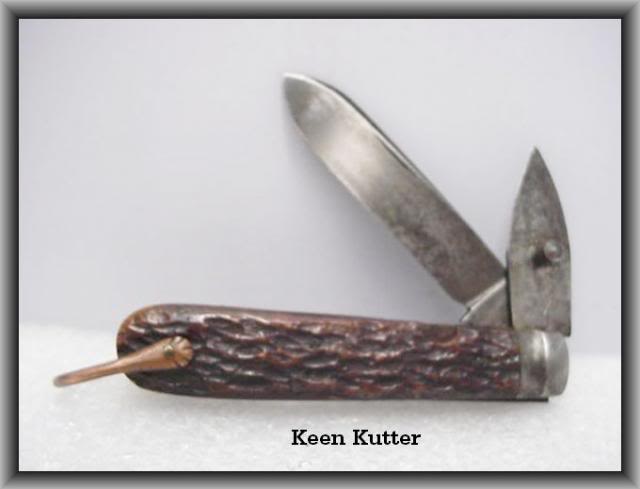
Meanwhile, here is the model without the spike and has jigged bone handles.
Re: WW1 Simmons Keen Cutter Clasp Knife Mystery!!
Posted: Fri Sep 06, 2013 1:26 am
by dutchy357
Hi Miller Bros.
They are all different!
My example has jigged fibre scales.
Your first example has chequered horn scales and your last example has jigged bone scales.
Are you sure they are jigged bone and not Stag? Because it is a remakable example of jigging if it is bone!!
Dutchy
Re: WW1 Simmons Keen Cutter Clasp Knife Mystery!!
Posted: Sat Sep 07, 2013 1:16 pm
by Miller Bro's
dutchy357 wrote:Are you sure they are jigged bone and not Stag? Because it is a remakable example of jigging if it is bone!!
Yes, it is jigged bone and you are quite right it is a very attractive bone handle!
Re: WW1 Simmons Keen Cutter Clasp Knife Mystery!!
Posted: Fri Sep 13, 2013 2:52 pm
by smiling-knife
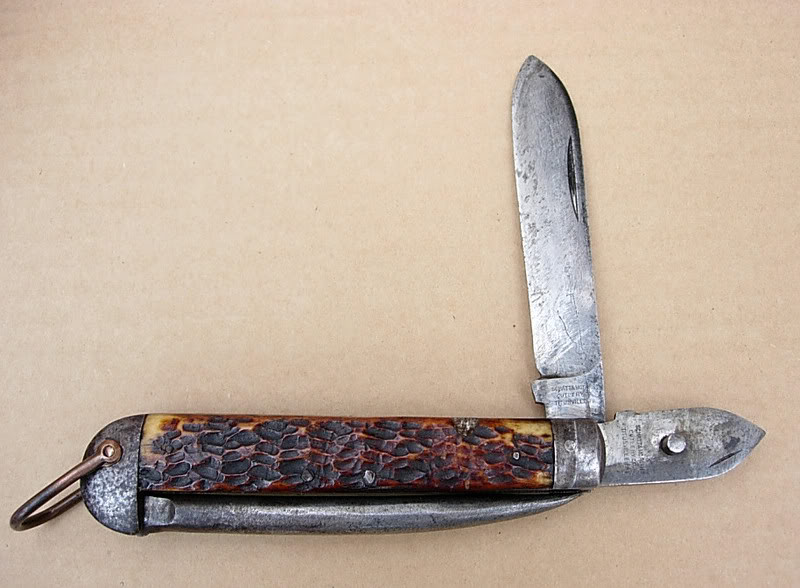
Sorry Dutchy, I don't know the answer to your question. This is a Schatt and Morgan example similar to the pattern posted by MB. I hope it is of interest.
Re: WW1 Simmons Keen Cutter Clasp Knife Mystery!!
Posted: Fri Sep 13, 2013 3:48 pm
by dutchy357
Thanks for that SK
The interesting thing is that so far I have found only about half a dozen of these knives. All are US made except one which is British. The British one is also different in that it has a sheepsfoot blade!!
The search goes on!
Dutchy
Re: WW1 Simmons Keen Cutter Clasp Knife Mystery!!
Posted: Fri Sep 13, 2013 3:54 pm
by jerryd6818
Dutchy -- The thrill and the frustration of collecting.

Re: WW1 Simmons Keen Cutter Clasp Knife Mystery!!
Posted: Fri Sep 13, 2013 5:57 pm
by Iron Hoarder
I'm pretty sure I have some English made ones of these in the parts/rebuild bag that have bexoid/plastic/vulcanite scales where the knife is good but the scales are shot. Next time I go through the bag I'll take pictures. There are no military marks on them.
Re: WW1 Simmons Keen Cutter Clasp Knife Mystery!!
Posted: Sun Sep 15, 2013 1:46 pm
by Mossdancer
dutchy357;
I am by know means an expert but I believe(maybe a bit strong, more like think) your two bladed example would have been included in one or all lifeboats onboard military ships. Most times only a rope knife would have been there. The copper shackle also would indicate Naval use possibly around caches of explosive items. I do think the tin opener would have been more fruitful in lifeboat situations for opening food stores. The three blade IMO was commonly known as a rigging or yachtsman's Knife. Any or all of them were used where and when needed. If they were around then any Sea Scout would have been proud to have owned one.
moss
Re: WW1 Simmons Keen Cutter Clasp Knife Mystery!!
Posted: Sun Sep 15, 2013 10:26 pm
by tjmurphy
K-nice K-nives fellerz. A quick question to you guys. Is the term
Clasp Knife a generic term used for any folding pocket knife??

This is the second pattern I've seen referred to as "Clasp Knife".
Re: WW1 Simmons Keen Cutter Clasp Knife Mystery!!
Posted: Sun Sep 15, 2013 11:41 pm
by Mossdancer
Here is the listing in LGIV Glossary of Cutlery Terms.
moss
Re: WW1 Simmons Keen Cutter Clasp Knife Mystery!!
Posted: Sun Sep 15, 2013 11:46 pm
by knifetime
I was reading in BGTK 8 just last night and rememberd this post when I came across the same type of knife as the o n e in question. It says they are made for the Canadian militaries.
Re: WW1 Simmons Keen Cutter Clasp Knife Mystery!!
Posted: Sun Sep 15, 2013 11:47 pm
by tjmurphy
Thanks Moss. Then the OP's are not considered "clasp knives", right? This would be the traditional clasp knife
Re: WW1 Simmons Keen Cutter Clasp Knife Mystery!!
Posted: Mon Sep 16, 2013 2:09 am
by dutchy357
tjmurphy wrote:K-nice K-nives fellerz. A quick question to you guys. Is the term
Clasp Knife a generic term used for any folding pocket knife??
This is the second pattern I've seen referred to as "Clasp Knife".
Hi tj
Good question.
Thanks mossdancer.

I have also found these definitions.
clasp knife
A pocketknife with a folding blade.
The American Heritage® Dictionary of the English Language,
a large knife with one or more blades or other devices folding into the handle
Collins English Dictionary – Complete and Unabridged
a large pocket knife having a blade or blades that may be folded into the handle.
Random House Kernerman Webster's College Dictionary
I use the term Clasp Knife particularly when referring to Military folding knives as they are commonly called Clasp Knives by the Military. They are also meant to be worn on a lanyard or a belt clip which means they are not "pocket knives".
The knife issued to Australian Soldiers in WW1 was "Knife, clasp, with marline spike, tin opener". In WW2 it was referred to as "Knife, clasp, and lanyard". It still had a tin opener and a marlin spike.
Terminology does change with time. If you notice the spike was referred to as a marline spike during WW1, these days it is call a marlin spike.
knifetime wrote:I was reading in BGTK 8 just last night and rememberd this post when I came across the same type of knife as the o n e in question. It says they are made for the Canadian militaries.
Thanks for that knifetime. Can you give me a link to that post please. My knife doesn't have a Canadian acceptance mark.
Regards Dutchy
Re: WW1 Simmons Keen Cutter Clasp Knife Mystery!!
Posted: Sun Sep 22, 2013 9:58 pm
by knife-nut
I've asked this question before in another post, but have never had an answer that made sense. Why did they use brass or copper bails on these? Someone answered that maybe it was because they were used around seawater, being copper was rust resistant. But they used steel liners and bolsters in the same knife. I can't understand the reason for using copper.
Re: WW1 Simmons Keen Cutter Clasp Knife Mystery!!
Posted: Mon Sep 23, 2013 5:45 am
by Iron Hoarder
knife-nut wrote:I've asked this question before in another post, but have never had an answer that made sense. Why did they use brass or copper bails on these? Someone answered that maybe it was because they were used around seawater, being copper was rust resistant. But they used steel liners and bolsters in the same knife. I can't understand the reason for using copper.
Because it was easier to bend and shape the ends. They started using steel when the copper supply became scarce during WWII.
Re: WW1 Simmons Keen Cutter Clasp Knife Mystery!!
Posted: Mon Sep 23, 2013 1:40 pm
by Mossdancer
Malleable, when struck by something else hard neither would throw a spark. That might have been part of the reason. Sparks are the bane of munitions, fuels anything ignitable. Go boom.
mossdancer
Re: WW1 Simmons Keen Cutter Clasp Knife Mystery!!
Posted: Mon Sep 23, 2013 1:56 pm
by dutchy357
Iron Hoarder wrote:
Because it was easier to bend and shape the ends. They started using steel when the copper supply became scarce during WWII.
What he said!!

