John Goins did a better job on this research of Camillus tang stamps than any other writer I have seen.
He was a careful researcher and writer.
If you will notice on page 43 of
Goins' Encyclopedia of Cutlery Markings, he lists two tang stamps that are very close. The difference is whether or not there are serifs on the letters. The difference would be whether the knife was made in 1915 or 1916.
The tang stamp on the small blade would have the arched top line for both years. While the words of the tang stamp on the main blade are the same, the font (or letter type) with which the stamp is written is different.
In 1915 the tang stamp on the main blade is stamped in letters that are "sans serif." This means without serif. The serif is the little hooks or curls at the ends of some of the letters. So the 1915 stamp has no serif.
See the picture below. Note there is a typo in the text. He says “Sams serif letters.” I am certain he meant to say "sans serif" letters.
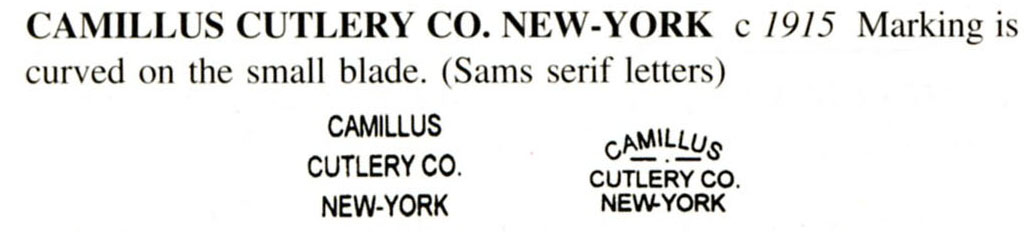
- Goins - Camillus 1915 Markings.jpg (45.17 KiB) Viewed 2129 times
In 1916 the tang stamp on the main blade is stamped with letters that have the serif.
You will notice them in the copy from Goins book listed below.
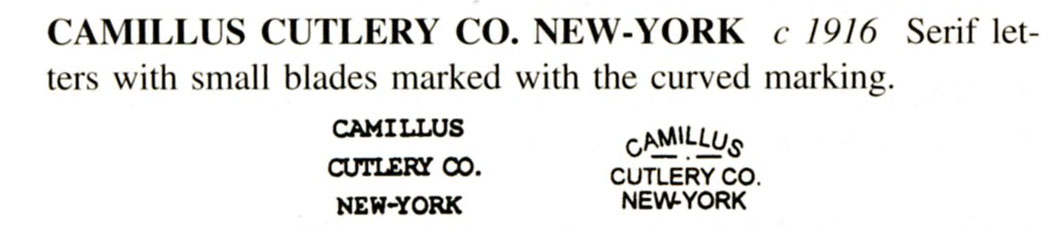
- Goins - Camillus 1916 Markings b.jpg (46.1 KiB) Viewed 2129 times
Notice that the lettering of the small blade does not change. Both years the small blades are stamped with sans serif letters. The only change is the letter style of the stamp on the master blade.
I cannot quite make out whether the tang stamp on the primary blade off TJ's knife is sans serif or with serif. I think it may be with serif, in which case the knife would be from 1916. If the stamp is sans serif then it is 1915.
A further note on Goins' abbreviations, the lowercase c before the letter means circa which means "approximately."
Perhaps it might seem like we're splitting hairs in discussing whether a knife was made approximately in 1915 or approximately in 1916, or whether the letters have serif or are sans serif. However, these little differences are sometimes the only clues we have in accurately identifying the date in which a knife was made. It may seem a small difference, but anyone who has ever navigated at night over unfamiliar territory in the dark can testify that a 1° or 2° error on the compass heading can put you miles out of position at the end of the course.
This is getting interesting.

Dale